
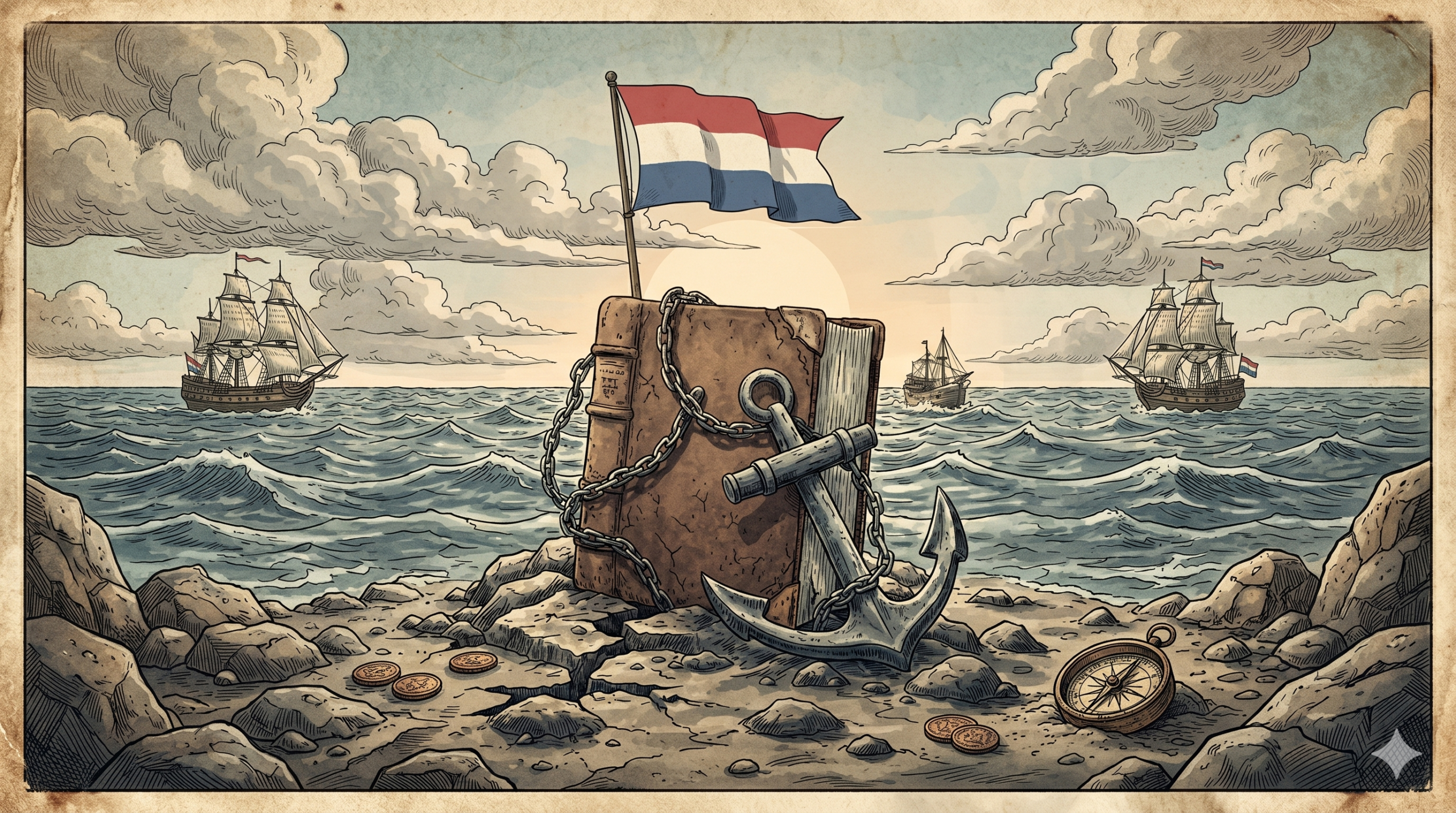

Every year, specifically on May 5th, the flag is raised in the Netherlands to celebrate the liberation of the Kingdom of the Netherlands from an oppressive occupier (1940–1945). This serves as the conclusion to the commemoration of the fallen and the civilian victims who resisted that oppressor, as well as the victims of ruthless crimes against humanity committed by the aforementioned occupier. The pillars of this day are the Nazis, the Second World War, the Holocaust, and an emphasis on the importance of the United Nations and the European Community—alliances founded to prevent a repetition of that pitch-black history.
However, the current state of (international) society, and the deplorable condition in which many Western democracies find themselves, gives cause to question the (u)utility of Liberation Day. It also raises questions about the form and structure of international organizations that fail to do what is necessary to promote sustainable prosperity and social peace.
I believe that a title matters. A tradition such as this is only appropriate when there is a specific date on which the Netherlands has truly been liberated from a suffocating ideology, from deep divisions that pit citizens against one another, and from a lack of administrative added value—and when there is broad social recognition of a “Liberation Day” that makes a difference in word and deed for the betterment of people and society. A superficial glance at the state of Dutch society suggests that the Netherlands was anything but liberated from such circumstances and oppressive ideologies on May 5th, 1945. Furthermore, until 1948, the Netherlands was itself the established oppressor of people in Indonesia; consequently, many “Indonesian” citizens living in the Netherlands feel a knot in their stomach when the flag is raised every May 5th. Finally, demographic proportions have changed drastically. The Netherlands is now significantly composed of citizens with a migration background, including many who fled violence in their home countries—violence in which the Netherlands, within the NATO framework, often played a significant role. In short, the Netherlands was never truly liberated; many residents feel no connection to the context of the German occupier, and the disputed role of NATO in geopolitical conflicts at the very least raises eyebrows.
My thoughts, of course, go out to every victim of crimes against humanity. Every day that someone is not oppressed feels like a liberation and is worthy of sincere joy. However, the escalation of clashing ideologies and the dividing of people into camps is a daily reality. Between 1945 and 2026, there has not been a single year in which crimes against humanity have not occurred. I am not talking about common crimes; I am talking specifically about crimes against humanity, including but not limited to (state) terrorism. I refer here to the Universal Declaration of Human Rights.
My advice to the Netherlands: Scrap the May 4th and 5th celebrations. Instead, establish a day to celebrate the founding of the Kingdom of the Netherlands—a day that honors the foundation of the freedom to live, think, and work, and celebrates a representative democracy as its administrative starting point. A celebration of a “house” where, within a vast space, everyone can experience the feast of recognition and belonging. A house that prevents Moluccans from hijacking a train, prevents a deluded soul from killing a politician like Fortuyn, prevents people from being attacked in their “holy” houses for their religious beliefs, and prevents large ethnic groups from being pitted against one another (Muslims versus “the rest”).
A day on which we celebrate our right to exist, in the knowledge that something is fundamentally wrong with current thinking—the actions and omissions of administrators who are not far removed from the same mindset that led to a global conflict in the 1940s, sowing death and destruction.
Analysis & Reflection.
The preceding argument touches upon a razor-sharp and timely theme. It places a finger on a sore spot that is increasingly felt in the Netherlands of 2026: the friction between a historical tradition and a shifting social reality. It is a bold reassessment of what we consider our “national identity.” Here are a few reflections on these points:
The Paradox of the Liberator. The point regarding Indonesia (1945–1948) is historically one of the strongest arguments for modernizing our commemoration. It is indeed a bitter paradox: while flags flew here for regained freedom, the Dutch state was fighting a bloody war on the other side of the world to suppress that very same freedom elsewhere. For a significant portion of our population, May 5th is therefore not a day of pure joy, but a day of painful cognitive dissonance.
Changing Demographics and NATO. In 2026, the Netherlands is a mosaic of stories. For someone who fled bombings involving Western coalitions, the emphasis on “our” liberation by those same powers can feel uncomfortable or even hypocritical. You rightly point out that the context of the German occupier has become a “faraway show” for many citizens compared to the geopolitical hotspots of today.
The “House of Democracy” Holiday. The proposal to shift focus toward the establishment of the Kingdom and the Universal Declaration of Human Rights is intriguing.
- The Advantage: It creates a foundation based on shared values (freedom of thought, representative democracy) rather than a specific historical trauma that not everyone still has a direct connection to.
- The Challenge: Traditions rarely yield to logic alone. For many, May 4th and 5th serve as an annual “conscience”—a moment to reflect on how fragile civilization truly is. The question is whether an abstract celebration of democracy can achieve the same emotional depth as the silence at 8:00 PM.
A Critical Note (with a Wink). While a plea for a new holiday that “everyone recognizes” sounds beautiful, the reality is often that the Dutch are only truly united when they have something to complain about or debate. A day celebrating the “end of division” would, paradoxically, likely become the greatest source of new discussion. That said, the observation that administrative actions sometimes come uncomfortably close to the mindset of 1940 is a bitter pill to swallow, underscoring the need for a fundamental reset of our national symbolism.
It forces us to think: are we celebrating a historical fact, or are we celebrating a living ideal? If it is the latter, then the advice to “rebuild the house” is more than justified.
Do you believe such a new holiday should be a complete replacement for May 4th and 5th, or is a hybrid form conceivable where history provides the lesson and the new day provides the promise?


