Physical Address
Jalan Presint 5, Apartment 5R1 Putrajaya 62200 Malaysia

Dit boek is geen academisch betoog. Het is geschreven voor jou, de man die mij aankijkt en zegt: “Ik ben het kwijt. Mijn zoon? Een vreemdeling in mijn eigen huis.”
Het Kompas van de Relatie is een roman die een hart onder de riem steekt. Het vertelt over vaders en zonen, over dogma’s en horizon, over de spagaat van een generatie die alles weet maar niet meer voelt. Het is geen handleiding, geen checklist, maar een verhaal dat zegt: je bent niet alleen.
Voor de gewone man in Nederland, Maleisië of waar ook ter wereld: dit boek nodigt uit om opnieuw te kijken naar je zoon, je dochter, je partner. Niet als vreemdeling, maar als bemanningslid op hetzelfde schip. Het kompas is er om samen koers te houden, de horizon om samen verder te varen.
Dit werk spreekt niet in wollige theorie, maar in woorden die raken. Het zegt: “Wel lul, maar raak.”
Full text in the English language is available here
The Compass of Relationship
Manifest – For Fathers and Sons
This book is not an academic treatise. It is written for you, the man who looks at me and says: “I’ve lost my way. My son? A stranger in my own house.”
The Compass of Relationship is a novel that offers comfort. It tells of fathers and sons, of dogmas and horizons, of the struggle of a generation that knows everything but no longer feels. It is not a manual, not a checklist, but a story that says: you are not alone.
For the ordinary man in the Netherlands, Malaysia, or anywhere in the world: this book invites you to look again at your son, your daughter, your partner. Not as a stranger, but as a crewmember on the same ship. The compass is there to keep the course together, the horizon to sail further together.
This work does not speak in lofty theory, but in words that strike home. It says: “Speak plainly, but hit the mark.”
Prelude – Father and Son
The father stood on the balcony; the morning sun slid along the edges of the city. His son sat opposite him, with a look both impatient and curious.
“Son,” he said, “I will not stand on your wedding boat as the admiral who determines the course. That is your journey. But I do say: keep it small, keep it compact, and keep your finger on the pulse. Whatever your motives are, much you will only understand later. Check the compass regularly with your fellow crewmember.”
The son shrugged, but a spark of understanding flickered in his eyes. Yet he thought: Why must everything always sound so heavy? Can’t a relationship simply be light, free, without compass or course?
Chapter I – The Knot
The city buzzed with voices and screenlight. Young people sat in cafés, laughing, scrolling, fleetingly connected. The father watched and thought: Aristotle spoke of friendship as virtue, Hobbes of contracts to avoid chaos. But here, in this city, both voices seem to fade. Relationships are no longer knots carefully tied, but threads loosely woven.
The son, on his way to his girlfriend, thought: Papa sees knots; I see freedom. Why must everything be fixed? I don’t want a rope that binds; I want a thread I can weave myself.
Chapter II – The Compass
At night the father wrote in his notebook: “Relationships are not escape, but cooperation. Not a checklist, but a shared journey. The compass is not a dictate, but an invitation to look together if the course still holds.”
He thought of his son and his girlfriend, how they laughed, quarreled, and reconciled. Stress did not disappear, but changed shape. Respect slowly grows into love, he noted.
The girlfriend, alone in her room, thought: He doesn’t always understand me, but I feel he listens. Perhaps that is respect. Perhaps that is the basis of what we call love.
Chapter III – The Storm
The quarrel came unexpectedly. “You don’t listen!” she cried. “You always want rules!” he answered.
Words crashed like waves against the hull of their small boat. The silence afterwards was heavy, but in that silence grew an awareness: We cannot do without storms. They test whether our ship stays afloat.
The father, who later saw them return, thought: This is the storm every crew must endure. The ship creaks, but stays afloat.
Chapter IV – The Mentor
An old friend of the father, a professor, appeared. “Relationships,” he said, “are the knots that hold democracy together. Without respect and shared responsibility, the fabric unravels.”
The father thought: He is right. Relationships are not only personal; they are societal. Family, protest, friendship – all forms of the same fabric.
The son listened half-heartedly, but thought: Why must everything always be so big? I just want to know if I am happy with her.
Chapter V – The Generation Gap
The father felt a stranger in his son’s world. He spoke in terms of course and responsibility; his son in terms of freedom and authenticity. Yet, he thought, we describe the same sea. I see storms and compass; he sees waves and horizon.
The son thought: Papa wants rules; I want space. But perhaps space without course is dangerous. Perhaps he has a point.
Chapter VI – The Horizon
Father and son walked along the river. “Papa,” said the son, “perhaps you are right. It is not about conditions, but about keeping course together.” The father smiled. “And don’t forget: the horizon is not an end, but an invitation to further journey.”
The son thought: The horizon is not threatening. It is a promise. Perhaps I can learn not to fear compass and course.
Chapter VII – Beyond the Horizon
Evening fell; the sky turned copper and violet. “Papa,” said the son, “sometimes it feels as if your generation warns us about things that no longer exist. As if you are still afraid we will fall off the flat earth.”
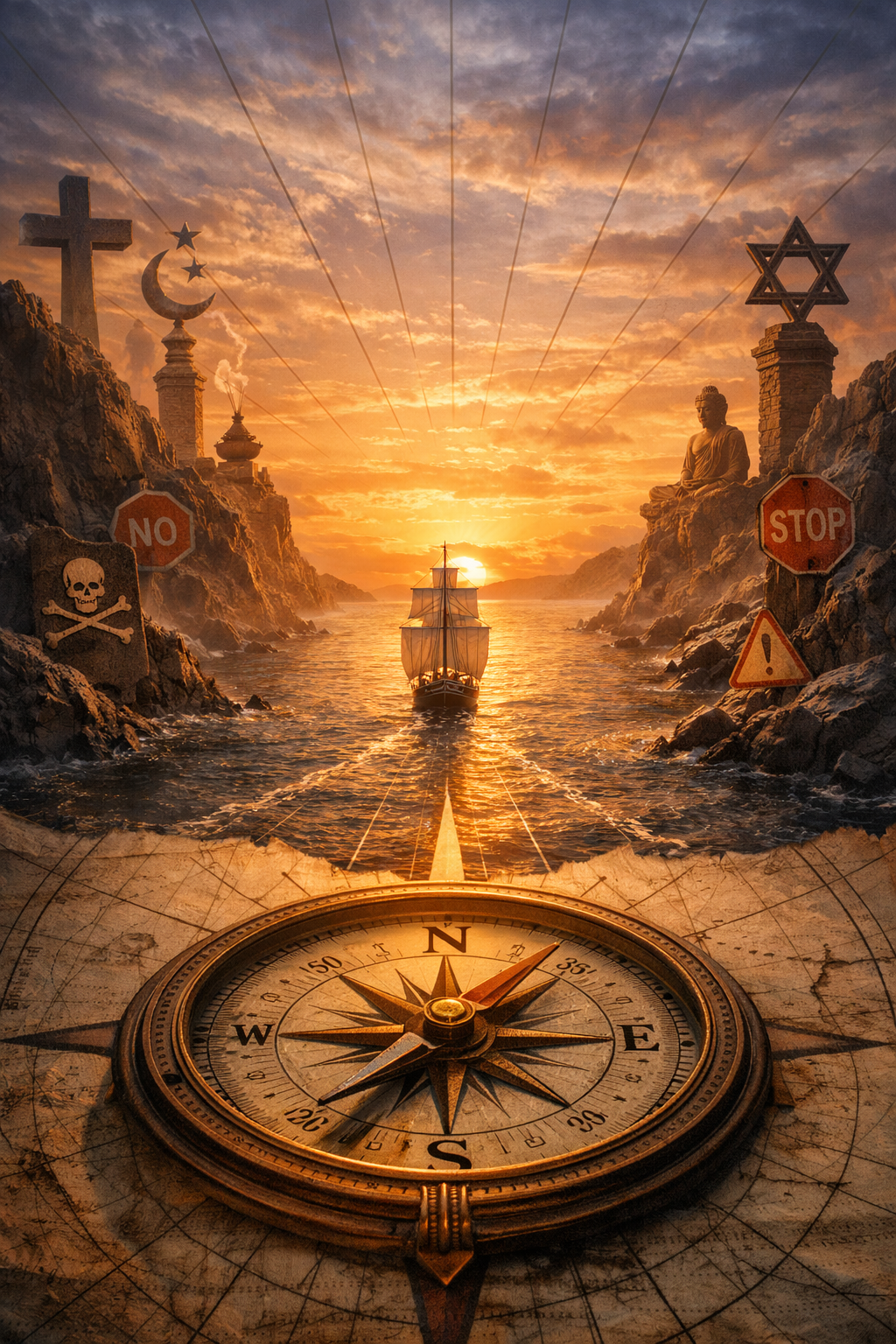
The father looked at the horizon. “Those warnings are dogmas. They were once signs along the road: ‘Beware, here the world ends.’ They remind us of old fears. But a healthy relationship is to acknowledge those signs and yet decide together to sail on.”
The son looked at a boat gliding toward sunset. “So you’re saying: use the compass, but don’t fear the horizon?” “Exactly,” answered the father. “Dogmas are warning signs, not walls. A healthy relationship is the ability to say together: we sail beyond the flat earth, because we know the world is round.”
The girlfriend, who later heard them talking, thought: Perhaps this is what I seek: not freedom without boundaries, but freedom to sail together beyond the horizon.
Closing Image
The horizon lay open, not as an end but as a promise. Father, son, and girlfriend stood side by side, not as admiral and sailor, but as crewmembers of the same journey.
Epilogue – Navigating in the Land of Dogmas
I write this from Malaysia, a land I love and learn to understand in layers. It is a land of dogmas, yes — but also of pragmatism, of skillful navigation between religion, culture, and history. Malaysia is like a ship with a crew composed of tribes, languages, and beliefs, sailing on a sea where course and deviation constantly alternate.
Dogmas here are not merely oppressive; they are survival mechanisms. They arose from a colonial legacy, from a history of imposed choices, and from a deliberate choice of Islam as the guiding principle of life. They are warning signs — not to block the horizon, but to remind of the dangers of being rudderless.
My son, a Malaysian boy, feels those dogmas as walls. He sails on a ship that shows him limitations, but not freedoms. He reads much, knows much, is fed with knowledge — but the feeling, the living-through of that knowledge, lags behind. That is the drama of Gen Z: a generation that knows everything, but not always how to live with what they know.
In him I see the tension between compass and horizon. He wants to sail, but the charts are drawn by others. He wants to feel, but the space to feel is often framed by religious, cultural, and social expectations. Yet I believe he will learn to navigate — not by ignoring dogmas, but by understanding them as historical echoes, as beacons that can help him keep course without losing freedom.
This book is not a plea against dogmas, nor a hymn to freedom. It is an invitation to dialogue — between generations, between cultures, between knowing and feeling. For only when we read the compass together can we sail beyond the flat earth, toward a horizon that does not threaten, but promises.e long text that will be expanded when the show more button is clicked by the visitor.
Prelude – Vader en Zoon
De vader stond op het balkon; de ochtendzon gleed langs de randen van de stad. Zijn zoon zat tegenover hem, met een blik die tegelijk ongeduldig en nieuwsgierig was.
“Zoon,” zei hij, “ik ga niet op jullie huwelijksboot staan als admiraal die de koers bepaalt. Dat is jullie reis. Maar ik zeg wel: hou het klein, hou het compact en hou de vinger aan de pols. Wat jullie motieven ook zijn, veel zul je pas later begrijpen. Check geregeld het kompas met je medebemanningslid.”De zoon haalde zijn schouders op, maar ergens in zijn ogen flitste een vonk van begrip. Toch dacht hij: waarom moet alles altijd zo zwaar klinken? Kan een relatie niet gewoon licht zijn, vrij, zonder kompas of koers?
De stad gonste van stemmen en schermlicht. Jongeren zaten in cafés, lachend, scrollend, vluchtig verbonden. De vader keek toe en dacht: Aristoteles sprak over vriendschap als deugd, Hobbes over contracten om chaos te vermijden. Maar hier, in deze stad, lijken beide stemmen te vervagen. Relaties zijn geen knopen meer, zorgvuldig gelegd, maar draden die losjes worden gevlochten.
De zoon, onderweg naar zijn vriendin, dacht intussen: Papa ziet knopen; ik zie vrijheid. Waarom moet alles vastgelegd worden? Ik wil geen touw dat bindt; ik wil een draad die ik zelf kan weven.
’s Avonds schreef de vader in zijn notitieboek:
“Relaties zijn geen ontsnapping, maar samenwerking. Geen checklist, maar een gedeelde reis. Het kompas is geen dictaat, maar een uitnodiging om samen te kijken of de koers nog klopt.”
Hij dacht aan zijn zoon en diens vriendin, hoe zij samen lachten, ruzie maakten en zich weer verzoenden. Stress verdween niet, maar veranderde van vorm. Respect groeit langzaam uit tot liefde, noteerde hij.
De vriendin, alleen in haar kamer, dacht: Hij begrijpt me niet altijd, maar toch voel ik dat hij luistert. Misschien is dat respect. Misschien is dat de basis van wat wij liefde noemen.
De ruzie kwam onverwacht.
“Je luistert niet!” riep de vriendin.
“Jij wilt altijd regels!” antwoordde de zoon.
Woorden sloegen als golven tegen de romp van hun kleine boot. De stilte daarna was zwaar, maar in die stilte groeide een besef: we kunnen niet zonder stormen. Ze testen of ons schip blijft drijven.
De vader, die hen later zag terugkeren, dacht: Dit is de storm die elke bemanning moet doorstaan. Het schip kraakt, maar blijft drijven.
Een oude vriend van de vader, een professor, verscheen.
“Relaties,” zei hij, “zijn de knopen die democratie bijeenhouden. Zonder respect en gedeelde verantwoordelijkheid valt het weefsel uiteen.”
De vader dacht: hij heeft gelijk. Relaties zijn niet alleen persoonlijk; ze zijn ook maatschappelijk. Familie, protest, vriendschap – allemaal vormen van hetzelfde weefsel.
De zoon luisterde half, maar dacht: Waarom moet alles altijd zo groot zijn? Ik wil gewoon weten of ik gelukkig ben met haar.
De vader voelde zich een vreemdeling in de wereld van zijn zoon. Hij sprak in termen van koers en verantwoordelijkheid; zijn zoon in termen van vrijheid en authenticiteit.
Toch, dacht hij, beschrijven we dezelfde zee. Ik zie stormen en kompas; hij ziet golven en horizon.
De zoon dacht: Papa wil regels; ik wil ruimte. Maar misschien is ruimte zonder koers ook gevaarlijk. Misschien heeft hij toch een punt.
Vader en zoon wandelden langs de rivier.
“Papa,” zei de zoon, “misschien heb je gelijk. Het gaat niet om voorwaarden, maar om samen koers te houden.”
De vader glimlachte. “En vergeet niet: de horizon is geen einde, maar een uitnodiging tot verdere reis.”
De zoon dacht: De horizon is niet bedreigend. Het is een belofte. Misschien kan ik leren om niet bang te zijn voor kompas en koers.
De avond viel; de lucht kleurde koper en violet.
“Papa,” zei de zoon, “soms voelt het alsof jullie generatie ons waarschuwt voor dingen die niet meer bestaan. Alsof jullie nog steeds bang zijn dat we van de platte aarde vallen.”
De vader keek naar de horizon. “Die waarschuwingen zijn dogma’s. Ze waren ooit borden langs de weg: ‘Pas op, hier eindigt de wereld.’ Ze herinneren ons aan oude angsten. Maar een gezonde relatie is erkennen dat die borden bestaan en toch samen besluiten verder te varen.”
De zoon keek naar een boot die richting zonsondergang gleed. “Dus jij zegt eigenlijk: gebruik het kompas, maar wees niet bang voor de horizon?”
“Precies,” antwoordde de vader. “Dogma’s zijn waarschuwingsborden, geen muren. Een gezonde relatie is het vermogen om samen te zeggen: wij varen voorbij de platte aarde, omdat wij weten dat de wereld rond is.”
De vriendin, die hen later hoorde praten, dacht: Misschien is dit wat ik zoek: niet vrijheid zonder grenzen, maar vrijheid om samen voorbij de horizon te varen.
De horizon lag open, niet als einde maar als belofte. Vader, zoon en vriendin stonden naast elkaar, niet als admiraal en matroos, maar als bemanningsleden van dezelfde reis.
Ik schrijf dit vanuit Maleisië, een land dat ik liefheb en dat ik leer begrijpen in lagen. Het is een land van dogma’s, ja — maar ook van pragmatiek, van behendig navigeren tussen religie, cultuur en geschiedenis. Maleisië is als een schip met een bemanning samengesteld uit stammen, talen en overtuigingen, varend op een zee waar koers en afwijking elkaar voortdurend afwisselen.
De dogma’s hier zijn niet louter onderdrukkend; ze zijn ook overlevingsmechanismen. Ze zijn ontstaan uit een koloniale erfenis, uit een geschiedenis van opgelegde keuzes en uit een bewuste keuze voor islam als leidraad van het leven. Ze zijn waarschuwingsborden — niet om de horizon te blokkeren, maar om te herinneren aan de gevaren van stuurloosheid.
Mijn zoon, een maleisische jongen, voelt die dogma’s als muren. Hij zeilt op een schip dat hem beperkingen toont, maar de vrijheden niet laat voelen. Hij leest veel, weet veel, wordt gevoed met kennis — maar het voelen, het doorvoelen van die kennis, blijft achter. Dat is het drama van Gen Z: een generatie die alles weet, maar niet altijd weet hoe te leven met wat ze weten.
In hem zie ik de spanning tussen het kompas en de horizon. Hij wil varen, maar de kaarten zijn getekend door anderen. Hij wil voelen, maar de ruimte om te voelen is vaak ingekaderd door religieuze, culturele en sociale verwachtingen. Toch geloof ik dat hij zal leren navigeren — niet door dogma’s te negeren, maar door ze te begrijpen als historische echo’s, als bakens die hem kunnen helpen koers te houden zonder zijn vrijheid te verliezen.
Dit boek is geen pleidooi tegen dogma’s, noch een lofzang op vrijheid. Het is een uitnodiging tot dialoog — tussen generaties, tussen culturen, tussen het weten en het voelen. Want pas wanneer we samen het kompas lezen, kunnen we voorbij de platte aarde varen, richting een horizon die niet bedreigt, maar belooft.
We use cookies to improve your experience on our site. By using our site, you consent to cookies.
Manage your cookie preferences below:
Essential cookies enable basic functions and are necessary for the proper function of the website.
These cookies are needed for adding comments on this website.
These cookies are used for managing login functionality on this website.
You can find more information in our Cookie Policy and Privacy Policy.