https://profpeter.online/the-architecture-of-profpeter-online/Physical Address
Jalan Presint 5, Apartment 5R1 Putrajaya 62200 Malaysia
From Content to Community: Your Safe Space for Intentional Living |
https://profpeter.online/the-architecture-of-profpeter-online/Physical Address
Jalan Presint 5, Apartment 5R1 Putrajaya 62200 Malaysia

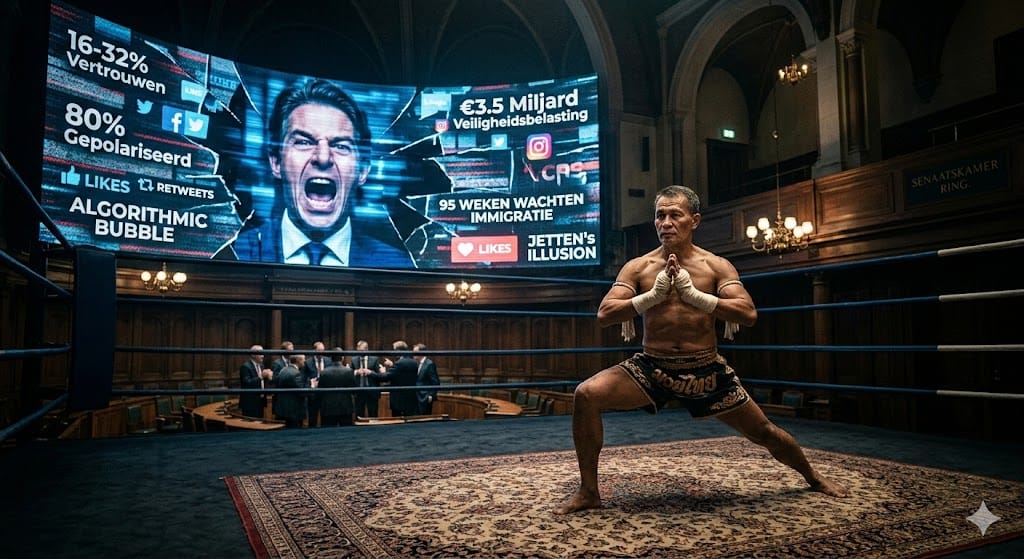
The Martial Art of Democracy: From Muay Thai Philosophers to Dopamine Politicians | With an Unblinking Stare on Organizational Psychology and Geopolitics
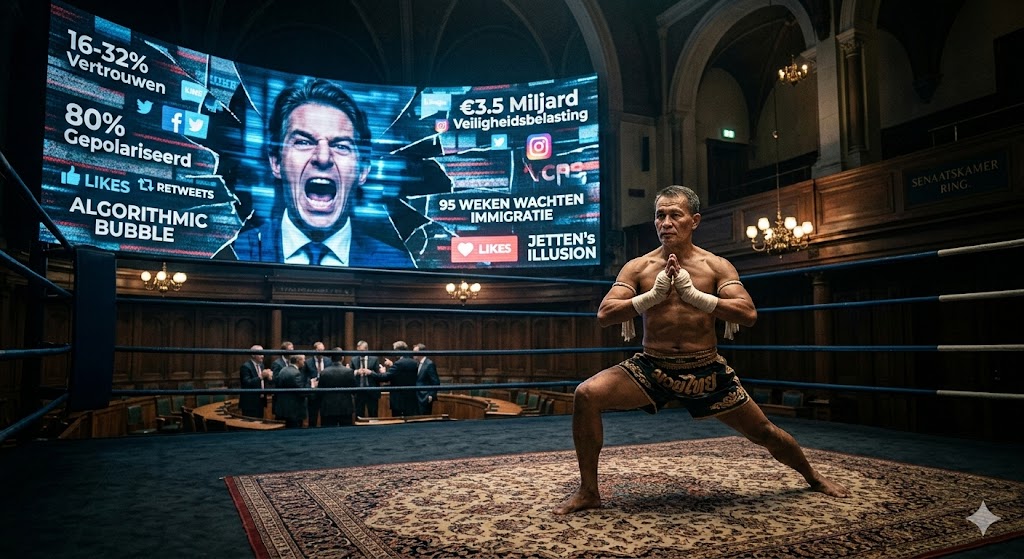
This article examines a global decline into mediocre political representation, using the Netherlands’ representative democracy as its central case study through pointed examples. From Muay Thai’s lost philosophy of respect to dopamine-driven governance, it reveals how core values erode under spectacle and ego.
Muay Thai, as pure martial art rooted in Buddhist discipline and physical transcendence, is not reduced by visionaries like Bruce Lee to merely defeating an opponent through brute force, tactical superiority, or momentary glory, but fundamentally defined by a deep-rooted, mutual respect for the sparring partner as a mirror of one’s own soul—a living, reactive instrument that exposes your stance, timing, intent, and emotional control, so the fight no longer targets flesh and blood, but the hidden limitations of your ego, visible only in the arena’s heat. The essence lies in voluntary surrender to this confronting learning process: the challenging partner is not an enemy to break or humiliate, but a catalyst for self-development as philosopher in the ring, consciously fueling the challenge and forcing choices that prioritize respect for the art itself—not the illusion of triumph or domination—bringing the challenger to their knees through refined, intuitive positional choice: deftly parrying attacks to assume a dominant yet never destructive stance that preserves mutual growth. This position intimidates through pure, controlled presence and moral superiority, inflicting no unnecessary harm that undermines reciprocal evolution or reduces it to mere suffering—for the challenger’s true helping hand lies precisely in exposing your loss of self-respect and self-inflicted pain, not through the physical blow itself, but at that crucial psychological moment when you betray the required ground stance—the core of discipline: emotions, driven relentlessly by ego, take over, causing fatal distraction that transforms the art into chaotic, self-destructive madness.
How far has modern martial arts drifted from these primal values of introspection and control, when fame as ultimate trophy, stare-down rituals as psychological intimidation, and inflicting pain as essential sensational show element artificially inflate entertainment value at the cost of dopamine hits for the audience, while inflicting profound, often irreparable damage to character—the moral, psychological core of discipline, humility, and mutual respect—reducing the sport to a caricature of its philosophical origin? It recalls the biting, prophetic satire in Life of Brian, where a mother and son boredly debate the day’s best spectacle—a bloody lion fight or medieval stoning—a painfully accurate unmasking of how this so-called ‘art,’ once a vehicle of self-transcendence, is rendered utterly ridiculous by the audience’s low, primitive expectations, seeking not personal elevation or collective wisdom, but raw cathartic sensation without reflection.
Project this distorted, commercialized dynamic onto politics as the ‘art’ of collective governance and conflict resolution, where at best every action, debate, and concession is governed by the described values of respect, emotional control, and mutual growth through failure, and you witness a tragic, recognizable caricature: replace Bruce Lee’s transcendental, adaptive ethos with Rob Jetten’s ostensibly sporty daring, the Muay Thai ring with the coveted Chambers of the States General, and the sparring partner with a fragile coalition of opportunism and identity politics. Jetten, who profiles himself as a boxing enthusiast with ambitious, physically disciplined mindset, seems bitterly ignorant of martial arts’ deeper core as life metaphor—his sharp, confrontational rhetoric, obsessive coalition drive, and focus on visible, measurable ‘wins’ in polls and headlines align seamlessly with promoters keeping the show profitable, not Lee’s timeless principle of “absorb what is useful, reject what is useless,” prioritizing radical adaptation, self-knowledge, and ego release over fleeting dominance. In 2026, trust in his vulnerable minority cabinet plummets to historic lows (16-32%), while polarization explodes via social media echo chambers and algorithmic bubbles—likes, retweets, and viral clips now fully dictate the political agenda, at the expense of philosophical depth, turning real failure into sustainable growth and institutional resilience.
The decay of governing institutions through all-encompassing dopamine mania of ‘likes,’ shares, and virtual applause creates a toxic bed that fundamentally repels and isolates those imposing self-limits—from deep-rooted preservation of values like mutual respect, discipline, and long-term thinking: no ‘honor to be gained’ in an arena where every interaction, idea, and identity is reduced to monetizable capital, emotional triggers, and superficial alliances.
Strictly technically, modern parliamentary democracy dates to Thorbecke’s liberal Constitution of 1848, institutionalizing ministerial responsibility and basic rights, but to truly diagnose and counter this system’s vulnerability to decay, we must graft its primal DNA to the 15th century: around 1464, with the first meeting of the States General under Burgundian rule in the Low Countries, a proto-democratic compromise emerged between the three pillars of what would become trias politica—church/religion/philosophy as society’s moral and ideological conscience, elite/nobility as hereditary power holder and order protector, and citizen/cities as economic engine and representative voice—where the church, long believing it knew all through divine mandate and infallible doctrine, was forced to cede significant ground in exchange for political and legal protection unavailable elsewhere in Europe, while the bourgeoisie with growing wealth and urban power compelled structured consultation and rudimentary power separation. This ‘rediscovered respect’ amid dire failure circumstances—religious schisms, Habsburg wars, economic crises—formed the psychological and institutional basis for representative governance: no absolute dominance, but mutual concessions enabling welfare development. Today’s bourgeoisie ignores this DNA, caricaturing trias into polarization.
The Netherlands overflows with data, yet the ruling generation consciously chooses low-level polarization (80% experiences division), corrupted algorithms, and likes over nuance. High level remains isolated; mediocre ‘martial arts’ thrives in bubbles.
The ‘security tax’—€3.5 billion in 2026 for Ukraine weapons—does not compensate diplomatic failure: Ukraine ‘white hat,’ Russia ‘black hat,’ no mediation. Escalation over control.
Advocates must mediate (art. 6:248 BW) under sanction threat; politicians ignore diplomacy—pure hypocrisy.
The chaotic musical chairs of immigration choices is dehumanizing: 95 weeks waiting time, limbo torture for refugees AND Dutch hosts. No diplomacy, only theater—suffering for all, end of exercise.
Corruption of history signals civilizational breakdown—historically with bloodshed.
AI clarifies patterns, doesn’t change nature’s course. Restore the soul, or bow.
The history of tomorrow turns this page—unless philosophers rise.

Forensic psychologist & researcher, author of “Prof. Peter’s Paper Trails”.
Decoding human behavior for SMEs and legal professionals across the EU and ASEAN.
We use cookies to improve your experience on our site. By using our site, you consent to cookies.
Manage your cookie preferences below:
Essential cookies enable basic functions and are necessary for the proper function of the website.
These cookies are needed for adding comments on this website.
These cookies are used for managing login functionality on this website.
You can find more information in our Cookie Policy and Privacy Policy.