


Saving the Mind from the digital crash, get rid of ‘Androidia’
You probably know the feeling: you’re working, reading, or trying to learn something new, and suddenly your phone buzzes. Your focus scatters in all directions. What once was concentration turns into a sort of panic response. It’s tempting to go along with the stream of notifications and distractions, but deep down, you know it doesn’t make you happier. This story ‘Androidia’ isn’t a plea for perfection—it’s an invitation to take back control of your own attention.
We often believe we can multitask, but our brains work differently. Every time you switch tasks, your mind has to readjust. It’s like you leave a piece of yourself behind with every notification. And it takes a while before you’re truly focused again. Research even shows that just having a silent phone nearby already makes you less sharp. You perform best when your phone is completely out of sight.
It’s not just your mind that suffers from all these digital impulses—your body takes a hit, too. That typical hunched posture over your screen—the so-called ‘text neck’—raises your stress levels and even mimics the physical signals of sadness. And working from your bed or couch might sound relaxing, but in reality, your brain gets less oxygen. You end up in a sort of limbo, zombie-scrolling, not really awake, not really resting either.
So how do you break free? By consciously organizing your digital life. Place your computer in a fixed spot and use it for what really matters: creative work, planning, and learning. Make a clear distinction between tools and toys. When you’re out and about, take a simple phone with you—one that only lets you call or send a message for emergencies. It might sound old-fashioned, but it brings peace of mind. A stable place and a fixed screen lead to a stable mind.
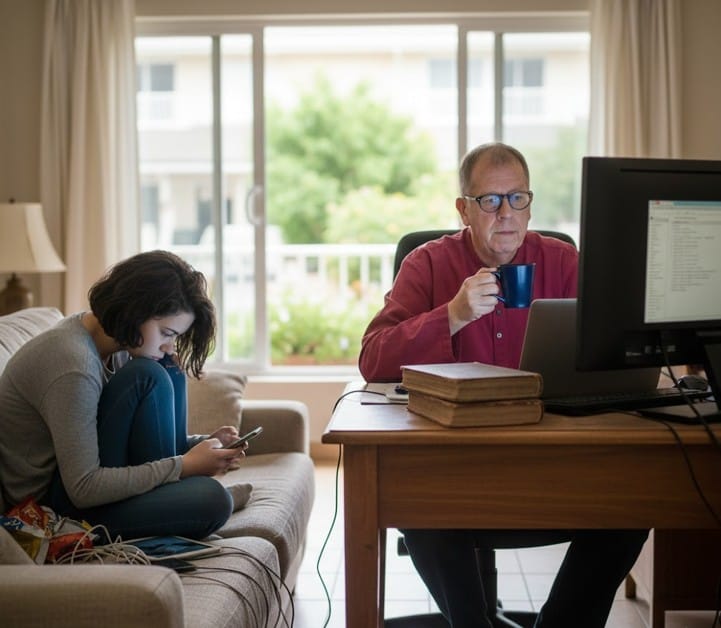
Sometimes, a good example works better than endless talk about rules. In one family, a stepfather moved his computer to a corner of the living room and worked there in full focus. The rest of the family naturally followed, without discussion. The calm that followed was striking: the ‘dino in the corner’ brought more quality than all the smartphones combined.
We often spend a lot of money on data plans, but rarely treat ourselves to a decent, permanent workspace—a true Baseline. And that’s exactly where the key lies. Love, learning, rest: it all starts with undivided attention. That may be the most valuable thing you possess.
So, make a pact with yourself: I choose to live with intention. I design my environment so that my attention doesn’t keep crashing. I built my own Baseline. I won’t crash.
What else could be said?
“We worry about our devices running out of battery, running out of storage, or crashing. But we rarely notice when the same thing happens to us. Building a Baseline isn’t about rejecting technology; it’s about remembering that you are the master, and the machine is the servant. The digital world will always be there, waiting, infinite, and indifferent. Your life, however, is finite. Choose where you look.”
Prof. Peter exercises the utmost care; all articles, research, and source documents are authentic unless explicitly stated otherwise.
None of the publications shall be interpreted as medical, psychological, or professional advice; they aim to provide profound insights rather than absolute truths.
In case of dispute, please email mohd@profpeter.online and we will sort it out in good faith.
Visually, this space is supported by custom illustrations created by Banana Pro, alongside digital conceptual AI aids.