

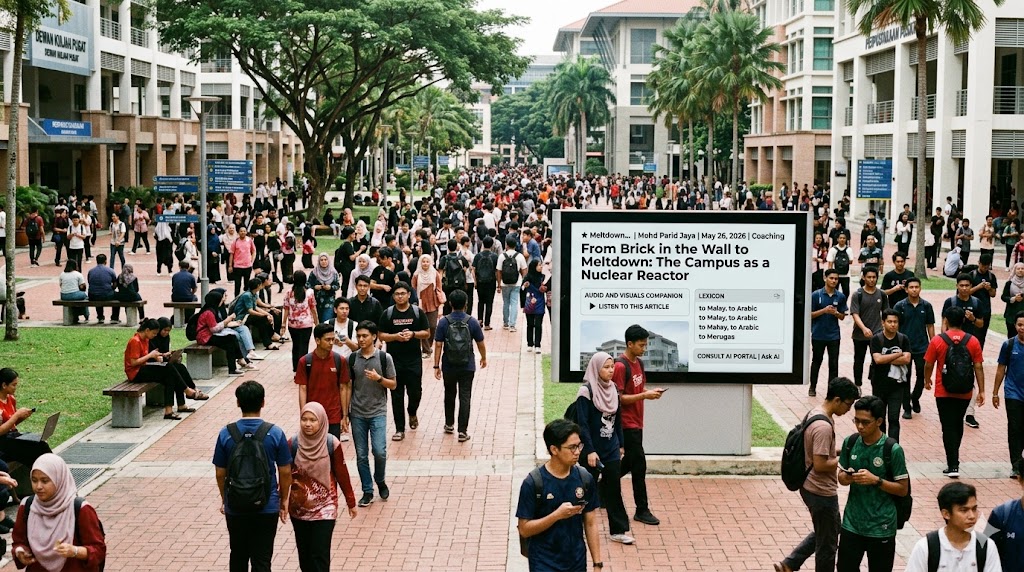
From Brick in the Wall to Meltdown: The Campus as a Nuclear Reactor

In 1979, Pink Floyd’s The Wall exposed the brutal mechanics of education as a “useful standards” factory. We all remember the haunting imagery: children moving uniformly on conveyor belts, their individuality systematically harvested to feed an industrial machine that demanded silence, compliance, and total assimilation.
But it’s 2026, and the systemic mechanics have been drastically upgraded. We are no longer dealing with a simple factory assembly line; we are dealing with the volatile physics of a nuclear power plant. The stakes today aren’t just “standardization”—they are “containment.”
The Biological Core of Modern Education
A modern campus is a collection of highly reactive biological cores: complex human entities that look identical on the surface but are governed entirely by the physics of mutual repulsion. This is a reactionary power plant designed to generate raw, unadulterated intellectual energy.
In a healthy educational ecosystem, this energy directly feeds the brain. Information isn’t just stored for rote memorization; it is held as a vital carrier for a future puzzle—a crucial piece of a larger societal composition whose grand purpose we may not yet fully comprehend.
The Teacher as the Control Rod
Within this academic reactor, the teacher’s traditional, foundational role is that of the neutralizing value—the control rod.
- The Mandate: Maintain the high intensity of the intellectual energy without dampening the critical spark.
- The Safety Protocol: Prevent the “core” (the student body) from overheating into blind, unreflective tribalism.
The educator is intended to be the ultimate structural buffer, allowing the volatile reaction of learning to safely occur without the entire plant exploding into social chaos.
The Ideological Short Circuit
The structural crisis we face today is that the neutralizing factor now desires to be an active, polarizing value. When a teacher abandons absolute pedagogical neutrality to forge a direct connection with a specific political ideology or religious dogma, a severe short circuit occurs.
The moment this happens, the “control rod” transforms into a “fuel rod,” adding unmanageable heat to the system instead of regulating it.
The Consequences of Critical Failure:
- Crisis Management: All operational energy produced by the campus plant is immediately diverted away from education and used to manage the resulting social and political fires.
- Function Loss: The primary purpose of the institution—true learning and deep “puzzling”—is isolated, pushed to the margins, and eventually abandoned.
- System Meltdown: By seeking to be an “active” ideological agent rather than a “neutral” academic guide, the educator completely cancels out their own systemic value, endangering the entire generational process.
The modern educational system is no longer producing light for the world; it is merely struggling around the clock to avoid a total, catastrophic meltdown.
“We don’t need no thought control.”
The timeless anthem of Pink Floyd remains profoundly true today, but the apparatus of control has shifted its face.
Watch the Visual Inspiration:
Experience the foundational imagery that started the conversation: Pink Floyd – The Wall