When you click the 📋 Copy button on any post, the exact title of that article is automatically saved to your clipboard.
You can then navigate to your personal page and paste the title under the Tools tab.
Pasting the title unlocks advanced features, allowing you to listen to the audio version of the article or join a live chat with peers to discuss the content in real time.
📖 Active Full-Width Article
📅 •✍️ By
💡 Tip: Double-click anywhere in the text area to close
A mantel clock (pendule) is a classic, often richly decorated chamber clock with a pendulum movement, designed to be placed on a mantelpiece, sideboard, or table. The name is derived from the French word for ‘pendulum’ (pendule), and it refers to the pendulum itself, which accurately regulates time. The clock utilizes a pendulum that swings back and forth at a fixed time interval to drive the movement—a principle based on the pendulum clock invented by Christiaan Huygens in 1656. The casing of a mantel clock is often a showpiece in itself, traditionally crafted from materials such as marble, bronze, brass, porcelain, or precious woods.
The Pendulum of the Female Body: A Behavioral Analysis
When drawing a comparison between the mechanical laws of this antique clock and the socio-emotional and behavioral forces surrounding the female body (The Pendulum of the Female Body), several profound paradoxes are exposed. The human observer who desires an object inherently exhibits a behavioral tendency to bend that desired object to their will. Thus, an individual can be compared to this beautiful clock: a showpiece put on display, operating under a strict schedule devised by an external “owner” and executed mechanically by a swinging pendulum.
Throughout history and into the present day, the individual is forced to move back and forth between rigid external systems. The female body was historically treated as the property of religious dogma, and subsequently, it has been claimed as the “possession” of feminist and liberal ideologies. The pendulum swings strictly between these ideological extremes. On one side of the arc, the message dictates that “the body belongs to God,” demanding modesty, vroom adherence, and submission to patriarchal institutions. On the other side of the arc, the message claims that “your body belongs to you alone, but you must immediately sign up for the prescribed tenets of feminism and modern liberalism.” The individual swings between these extremes, continuously forced to react to external pressures, while the overarching housing remains completely fixed in place. The movement is not a linear journey toward radical, self-determined progress; it is a repetitive, mechanical cadence within a pre-engineered box, functioning primarily to entertain the external “owners” of the debate.
Viewed strictly from the perspectives of behavioral science, sociology, and system theory, this constant swinging reveals how deeply external control structures impact human psychology. First, treating an individual as a “showpiece” highlights a fundamental process of objectification and ownership. While the object possesses an intrinsic value, that value is continuously determined, curated, and exhibited by an outside force.
When an external social system drapes itself protectively or correctively over a person—even with the best of intentions—it frequently triggers the psychological phenomenon known as learned helplessness (aangeleerde hulpeloosheid). If the rules of engagement, expectations, and frameworks are constantly dictated from the outside, the individual learns that their own intrinsic motivation and actions have no bearing on the ultimate outcome. The behavioral result is passivity, apathy, chronic suspicion, and depression. The joy of genuine autonomy disappears because the internal locus of control is entirely overridden.
This friction exposes a fundamental behavioral riddle: the conflict between individual autonomy (“master of one’s own body”) and social interdependence. Human beings are biologically and socially wired to live in connection with an environment. The absolute liberal concept of individual freedom often crashes into the reality of shared social structures. How “master of one’s own body” is supposed to relate to a wider environment remains an unsolved mystery. When the underlying systemic message reads, “You are entirely free and responsible for your own happiness, but you must function perfectly within our prescribed norms,” intense cognitive dissonance occurs. This conflict breeds deep argwaan (suspicion) regarding the true intentions of this systemic “freedom.”
Furthermore, the reality that “the fruit does not spontaneously hang from the tree” highlights that reproduction, sexuality, and the human body are never purely isolated biological functions; they possess a value shared with a third party, deeply embedded in a complex matrix of evolutionary, social, and relational interests. However, the moment this shared value mutates into an external claim—where the surrounding environment dictates exactly what the value of that body or fruit should be—the dynamic shifts drastically from mutual cooperation to rigid regulation. The human psyche responds poorly to constant external regulation; it activates chronic stress responses instead of fostering well-being or genuine happiness.
Ultimately, it is highly understandable how a society strives to break free from the yoke of an oppressive ideology. Yet, the supreme irony of political psychology and sociology is that the liberators almost systematically deploy the exact same structures and instruments of power against which they originally rebelled. In behavioral science, this is recognized as isomorphism—the tendency of opposing systems to adopt the same form.
When a movement dismantles an oppressive framework, a structural vacuum is created. Because human psychology and social systems deeply abhor a vacuum, the new leaders instinctively grasp for the tools they know best: the regulatory instruments of the old oppressor. The underlying behavioral mechanisms used to enforce conformity—such as social exclusion, moral superiority, dogmatic language, and the disciplining of dissidents—remain entirely universal. The content of the ideology changes, shifting from religious piety to hyper-individualism, but the psychological blueprint remains identical. To protect the newly won “freedom,” the liberators begin to dwingend (forcibly) regulate it, rationalizing their coercive methods because their intentions are deemed “good.” They fail to see that they have looked into the mirror and assumed the exact guise of the force they just expelled.
In the end, the individual looks at the new liberators and intuitively senses that while the rhetoric has changed, the chains have merely been painted a different color. The pendulum swings forcefully to the opposite side, but the grand mechanical clockwork driving the swing has not shifted an inch.
The Pendulum of the Female Body: A Behavioral Analysis
📅 June 17, 2026•✍️ mohdparidjaya
‘Proxy-Manager of One's Own Womb’ This contribution offers a creative insight into the twists of fate experienced by...
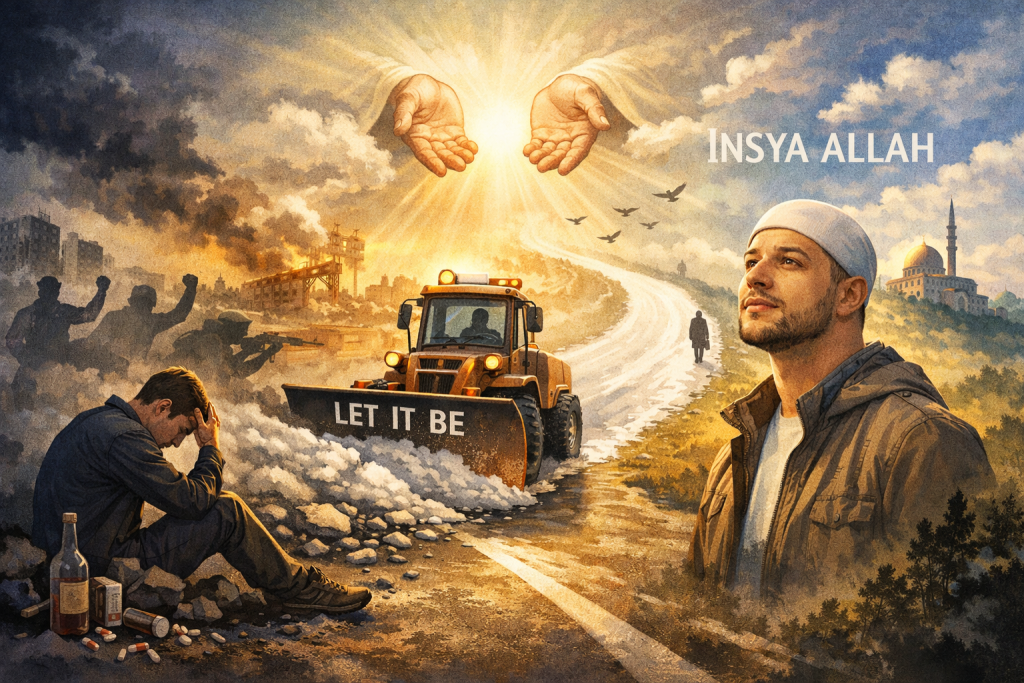
Paul McCartney wrote “Let It Be” to bring himself peace during a highly stressful period. Overwhelmed by tensions and arguments within The Beatles, he had a comforting dream where his late mother, Mary—who passed away when he was 14—appeared to reassure him by saying, “It will be all right, just Let it Be”
Let it Be
Discoveries, new labels, new contradictions, and thus fresh human battles over the meaning of the discovery: opportunities to fight one another, and so the world keeps turning on its axis. Paul McCartney’s ‘Let It Be’, a song written at a time when societies were in turmoil and everything was thrown into the battle to liberate societies from the perceived yoke, doctrines, and imposed lifestyles, was answered by Paul with a deadpan “let it be,” nowadays often translated as ‘who cares’.
Maher Zain wrote the motivational song “Insya Allah” to inspire people to never lose hope during difficult times and to remind them to keep their faith and trust in Allah. He wanted to create an uplifting message that brings comfort to listeners when they are feeling lost or hopeless
Manifesto of Recognition
You do not need a dominator to be oppressed.
Oppression can also come from within: from addiction, from forced activism, from the despair your own mess leaves behind.
Maher’s voice says: Recognition is responsibility. Without wisdom, no prosperity. Without forgiveness, no tomorrow.
And so, like a snowplow, Let It Be pushes the madness aside, And Insya Allah points the way upward. Never despair. Keep on rolling.
Insya Allah
Let it Be
📅 June 16, 2026•✍️ mohdparidjaya
Donald Trump, in his capacity as US President, considered a birthday gift and purchased a war with Iran...
This article examines a global decline into mediocre political representation, using the Netherlands’ representative democracy as its central case study through pointed examples. From Muay Thai’s lost philosophy of respect to dopamine-driven governance, it reveals how core values erode under spectacle and ego.
The Martial Art of Democracy: From Muay Thai Philosophers to Dopamine Politicians
With an Unblinking Stare on Organizational Psychology and Geopolitics.
Muay Thai, as pure martial art rooted in Buddhist discipline and physical transcendence, is not reduced by visionaries like Bruce Lee to merely defeating an opponent through brute force, tactical superiority, or momentary glory, but fundamentally defined by a deep-rooted, mutual respect for the sparring partner as a mirror of one’s own soul—a living, reactive instrument that exposes your stance, timing, intent, and emotional control, so the fight no longer targets flesh and blood, but the hidden limitations of your ego, visible only in the arena’s heat.
The essence lies in voluntary surrender to this confronting learning process: the challenging partner is not an enemy to break or humiliate, but a catalyst for self-development as philosopher in the ring, consciously fueling the challenge and forcing choices that prioritize respect for the art itself—not the illusion of triumph or domination—bringing the challenger to their knees through refined, intuitive positional choice: deftly parrying attacks to assume a dominant yet never destructive stance that preserves mutual growth.
This position intimidates through pure, controlled presence and moral superiority, inflicting no unnecessary harm that undermines reciprocal evolution or reduces it to mere suffering—for the challenger’s true helping hand lies precisely in exposing your loss of self-respect and self-inflicted pain, not through the physical blow itself, but at that crucial psychological moment when you betray the required ground stance—the core of discipline: emotions, driven relentlessly by ego, take over, causing fatal distraction that transforms the art into chaotic, self-destructive madness.
Contemporary Martial Arts: Glory Over Respect
How far has modern martial arts drifted from these primal values of introspection and control, when fame as ultimate trophy, stare-down rituals as psychological intimidation, and inflicting pain as essential sensational show element artificially inflate entertainment value at the cost of dopamine hits for the audience, while inflicting profound, often irreparable damage to character—the moral, psychological core of discipline, humility, and mutual respect—reducing the sport to a caricature of its philosophical origin?
It recalls the biting, prophetic satire in Life of Brian, where a mother and son boredly debate the day’s best spectacle—a bloody lion fight or medieval stoning—a painfully accurate unmasking of how this so-called ‘art,’ once a vehicle of self-transcendence, is rendered utterly ridiculous by the audience’s low, primitive expectations, seeking not personal elevation or collective wisdom, but raw cathartic sensation without reflection.
Politics as a Degenerate Ring:PM Rob Jetten‘s Illusion
Project this distorted, commercialized dynamic onto politics as the ‘art’ of collective governance and conflict resolution, where at best every action, debate, and concession is governed by the described values of respect, emotional control, and mutual growth through failure, and you witness a tragic, recognizable caricature.
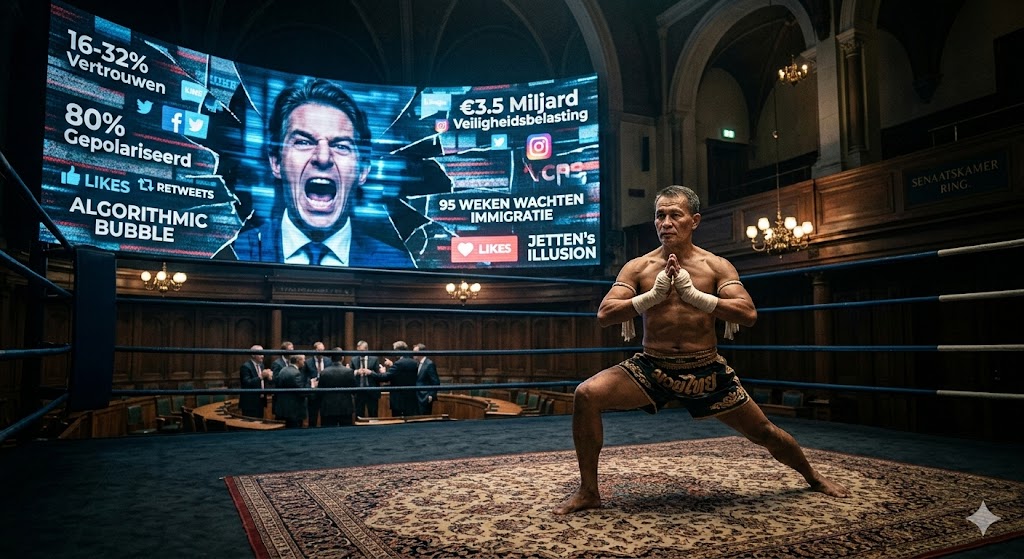
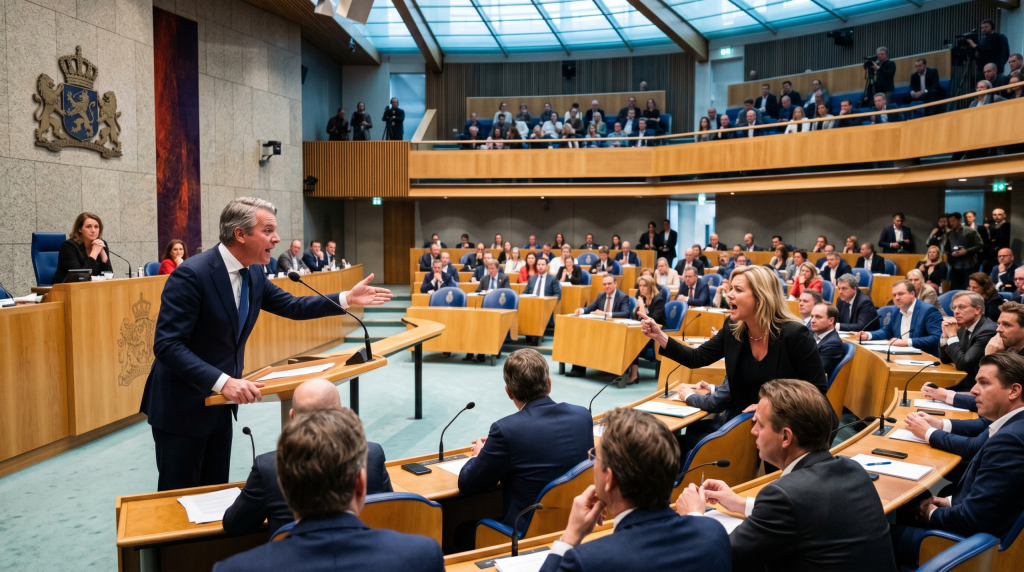
Replace Bruce Lee’s transcendental, adaptive ethos with Rob Jetten’s ostensibly sporty daring, the Muay Thai ring with the coveted Chambers of the States General, and the sparring partner with a fragile coalition of opportunism and identity politics.
Jetten, who profiles himself as a boxing enthusiast with ambitious, physically disciplined mindset, seems bitterly ignorant of martial arts’ deeper core as life metaphor—his sharp, confrontational rhetoric, obsessive coalition drive, and focus on visible, measurable ‘wins’ in polls and headlines align seamlessly with promoters keeping the show profitable, not Lee’s timeless principle of “absorb what is useful, reject what is useless,” prioritizing radical adaptation, self-knowledge, and ego release over fleeting dominance.
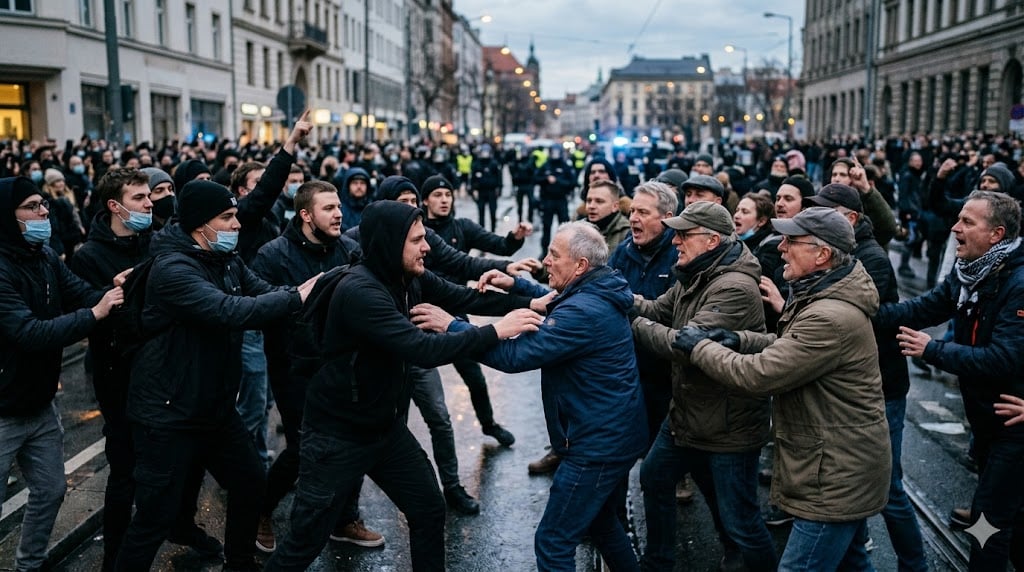
In 2026, trust in his vulnerable minority cabinet plummets to historic lows (16-32%), while polarization explodes via social media echo chambers and algorithmic bubbles—likes, retweets, and viral clips now fully dictate the political agenda, at the expense of philosophical depth, turning real failure into sustainable growth and institutional resilience.
The decay of governing institutions through all-encompassing dopamine mania of ‘likes,’ shares, and virtual applause creates a toxic bed that fundamentally repels and isolates those imposing self-limits—from deep-rooted preservation of values like mutual respect, discipline, and long-term thinking: no ‘honor to be gained’ in an arena where every interaction, idea, and identity is reduced to monetizable capital, emotional triggers, and superficial alliances.
Democratic DNA: The 1464 Compromise
Strictly technically, modern parliamentary democracy dates to Thorbecke’s liberal Constitution of 1848, institutionalizing ministerial responsibility and basic rights, but to truly diagnose and counter this system’s vulnerability to decay, we must graft its primal DNA to the 15th century: around 1464, with the first meeting of the States General under Burgundian rule in the Low Countries, a proto-democratic compromise emerged between the three pillars of what would become trias politica—church/religion/philosophy as society’s moral and ideological conscience, elite/nobility as hereditary power holder and order protector, and citizen/cities as economic engine and representative voice—where the church, long believing it knew all through divine mandate and infallible doctrine, was forced to cede significant ground in exchange for political and legal protection unavailable elsewhere in Europe, while the bourgeoisie with growing wealth and urban power compelled structured consultation and rudimentary power separation.
This ‘rediscovered respect’ amid dire failure circumstances—religious schisms, Habsburg wars, economic crises—formed the psychological and institutional basis for representative governance: no absolute dominance, but mutual concessions enabling welfare development. Today’s bourgeoisie ignores this DNA, caricaturing trias into polarization.
Generational Choice for Mediocrity
The Netherlands overflows with data, yet the ruling generation consciously chooses low-level polarization (80% experiences division), corrupted algorithms, and likes over nuance. High level remains isolated; mediocre ‘martial arts’ thrives in bubbles.
What more to say?
When you look at it through the lens of Desidarius Erasmus, a few things become painfully clear:
1. The Erasmian Irony of “Voter as Government”
If each voter is a micro-reflection of the government, and the government is the macro-sum of the voters, then the decay described in the article isn’t a top-down imposition. It’s an echo chamber. Erasmus’s Praise of Folly was all about how society willingly embraces illusions because reality is too uncomfortable.
We claim we want serious governance, but our collective data footprint, our algorithmic clicks, and our votes reward the “dopamine politicians.”
If the chamber is a circus, it’s because the market for circus tickets is booming.
2. Sidelining Science for “Applied Science”
The point about bending the knee to globalism and allowing “applied science” to sideline pure science is a crucial nuance.
Pure science requires the same discipline as the classical martial artist: sitting with uncertainty, rigorous self-correction, admitting when you are wrong, and playing the long game.
Applied science (in the political context) is often weaponized science. It’s data parsed through a consulting firm to justify a pre-determined policy, or a technocratic metric used to quieten debate. It’s “science” turned into a management tool to handle globalist supply chains and macro-demographics, stripped of its philosophical integrity.
3. The Theater Ticket as the Ultimate Tax Cop-Out
This is the most bitter joke of all. When citizens completely lose faith that the Tweede Kamer (Chambers) can actually solve systemic crises—housing, climate, inflation—the psychological contract changes:
The Old Contract: I pay taxes, you provide structural societal solutions. The New Contract: I pay taxes, nothing changes, so I might as well enjoy the screaming match on my timeline.
The tax money effectively becomes a theater subscription fee. If Rob Jetten or any other politician trips up, gets caught in a viral gaffe, or a coalition collapses, it’s no longer viewed as a tragedy for statecraft—it’s viewed as a season finale.
By treating politics as a soap opera, the public gains a sense of cynical superiority (“See? I knew they were all corrupt/incapable anyway”), but they forfeit the very soul of the democratic experiment. It’s a total abdication of the 1464 DNA, where real, structural skin-in-the-game forced people to compromise. Today, if the ship is sinking, at least the light show is spectacular.
It begs the question: if the electorate has fully transitioned from stakeholders to a theater audience, can a system built on mutual respect and “sparring” ever actually be rebooted? Or is the dopamine loop simply too addictive to break?
I conclude with a minimalist stand ‘ Consensus over Selfies’ for decennia the hallmark of ‘Dutch Politics of the polder’.
For decades, the entire hallmark of Dutch politics was the quiet, unglamorous art of consensus. It was born out of literal survival—if the pillars of society (whether the Church, Nobility, and Bourgeoisie in 1464, or the Catholics and Socialists of the 20th century) didn’t sit down and cooperatively drain the water, the entire country would drown. It required stripping away the ego, closing the doors, and making painful, pragmatic compromises for the collective good.
And we traded it for the selfie.
The front-facing camera is the absolute engine of the “dopamine politician.” It requires no long-term vision, no structural concessions, and no deep historical stance. It only requires a ring-light, an curated smile, and a viral quote-tweet to score quick, tribal points inside an algorithmic bubble.
The Erasmian Balance Sheet
By merging insights with the article’s core arguments, we are left with a profoundly sharp diagnosis of our current democratic state:
The Actor Paradox: We have a system where the 150 members of the Tweede Kamer are structurally bottlenecked, drowning in bureaucratic text, and functionally incapable of delivering true oversight or hyper-rapid legislative solutions. Yet, they cling to their seats, attempting to anchor their globalist frameworks into the constitution before the floor drops out beneath them.
The Tech Disruption: Generative AI can out-produce human policy generation a thousand times over in a single hour. It breaks the old 19th-century illusion that parliament’s primary job is to write text.
The Audience Betrayal: Because the public intuitively senses this uselessness, the psychological contract has shattered. We no longer pay taxes expecting structural solutions; we pay them like a theater subscription fee to watch the gladiatorial soap opera play out on our timelines.
The Final Round
If democracy is going to survive the collapse of its 19th-century institutional shape, the theater has to stop. The political class cannot continue to hide behind public relations teams and superficial brand management while globalist forces and “applied science” strip the nation of its philosophical sovereignty.
If the historical memory of the Brothers de Witt teaches us anything, it’s that when a technocratic elite insulates itself too deeply within its own legal fortresses—ignoring the raw, visceral realities of the people outside—the crowd eventually stops buying theater tickets. They drag the actors off the stage.
The transition out of this “dopamine ring” won’t be clean. But recognizing the shift from the hard-fought compromise of 1464 to a generation choosing low-level polarization for internet clout is the first step in clearing the arena. The polder is still flooding; it’s time to put down the phones, stop posing for the cameras, and find the ground stance again.
The Martial Art of Democracy
📅 June 15, 2026•✍️ mohdparidjaya
The Martial Art of Democracy: From Muay Thai Philosophers to Dopamine Politicians | With an Unblinking Stare on...
Beyond Noise. The Wind of Mutual Respect in 1447H
“In the dust of collapse, we share bread. In the shadow of blame, we offer light. Selamat Hari Raya.” Hari Raya Edition.
Prelude: Forgive Me.
” Forgive me for my flaws, for the words that may fall short, and for the silences that may have wounded. Hari Raya is not only a celebration—it is a ritual of forgiveness, a chance to mend the threads of dignity between us.“
Standing at the Gates.
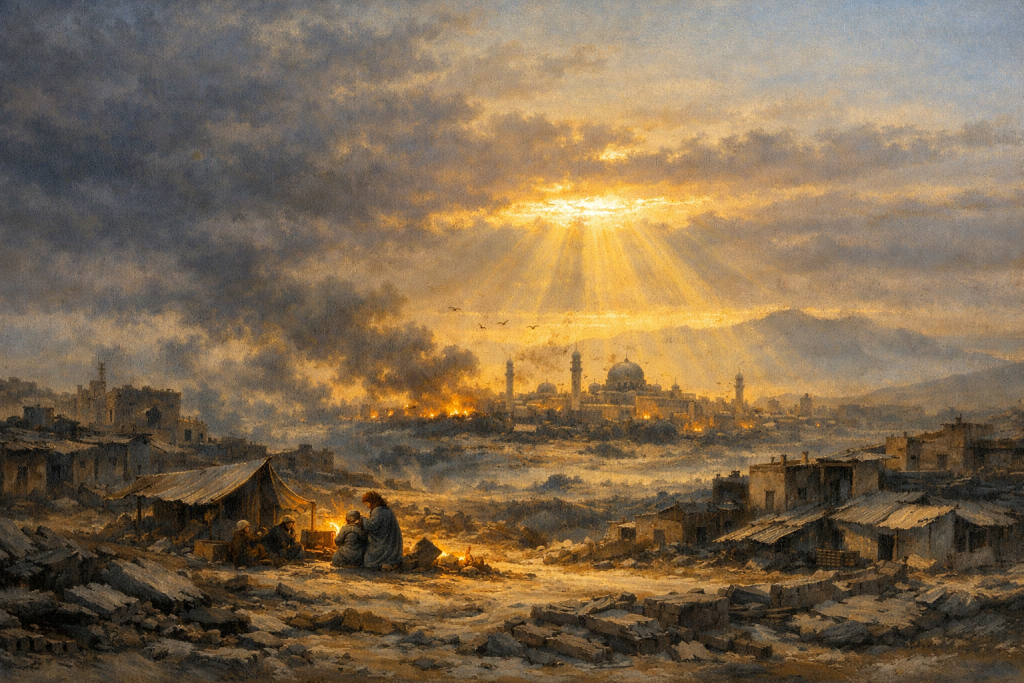
As we stand at the gates of 1447 Hijri, I know many of you look to this platform for answers. You seek wisdom to break through the Dust—the dust of conflict we see on the news, the dust of the streets where our neighbors sleep without a roof over their heads, and the digital noise that fills our ears but leaves our hearts empty.
I am not a man who walks on water. I have not flown to the heavens to bring back divine secrets. I am, just like you, merely a traveler standing in the wind.
The Answer Is Not Out of Reach.
Sixty years ago, a young poet told us that “the answer is blowing in the wind.” We often misunderstand that, as if the answer is elusive or invisible. But wind is what gives wings their lift. Without it, engines just make noise, burn fuel, and go nowhere.
In our lives, Love and Mutual Respect are that wind. The ‘Common Sense’ we so desperately need is not a complex political theory or a new technology. It is the radical act of seeing the person next to us—not as a ghost on the street or a profile on a screen, but as a soul deserving of dignity.
The Dust of Brutality.
But the dust is no longer only a metaphor. It is the dust of collapsed homes in Gaza, the dust of streets where children search for bread, the dust of silence after bombs. And in Europe, even the sacred act of breaking fast—an iftar in the Tweede Kamer—was turned into a chamber of division, where hospitality became a battlefield of symbols.
The ignorance and the blame games carried out in Western civilization are breathtaking. Enough. One cannot ignore the signals of apocalypse when they stand in plain sight: children buried under rubble, parliaments unable to share bread without suspicion, neighbors treated as shadows instead of souls.
The Wind of Mutual Respect.
If we cannot share bread without suspicion, if we cannot let the wind of respect pass through our institutions, then we are left only with noise. The brutality in the Middle East is not far away—it echoes in our parliaments, our chambers, our rituals.
This is not prophecy. It is an observation. The apocalypse is not a hidden code—it is the erosion of dignity, the collapse of respect, the noise that drowns out the human soul.
Becoming the Wing.
So let us stop trying to ‘acquire’ wisdom as if it were a trophy. Instead, let us try to be the wings that catch the wind.
Be peace where there is war. Be bread where there is hunger. Be listening where there is noise.
The answers to how many roads a man must walk are not found in law books; they are found in how we treat each other while we walk.
A Wish for Hari Raya.
On this Hari Raya, I wish you forgiveness, dignity, and renewal. May we mend what is broken, may we share bread without suspicion, and may we breathe respect into every chamber of power and every home.
Selamat Hari Raya. Maaf zahir dan batin.
Listen to the Rhythm: Bob Dylan – Blowin’ in the Wind (Official Audio)
Beyond Noise
📅 March 20, 2026•✍️ mohdparidjaya
The Wind of Mutual Respect in 1447H “In the dust of collapse, we share bread. In the shadow...
Giving Blowin’ in the Winda Qur’anic Sense.
🌙 Purpose 1447H
Prelude: Forgive Me
Forgive me for my flaws. Forgive me if my words fall short. This is not a post of spectacle, but of purpose.
Qur’an and Dylan: Rhythm of Guidance
Qur’an (Divine Guide)
Dylan (Human Echo)
“O you who believe! Why do you say what you do not do? Most hateful it is with Allah that you say that which you do not do.” (Surah as‑Saff 61:2‑3)
“How many times must a man look up before he can see the sky?”
“Indeed, Allah commands you to render trusts to whom they are due and when you judge between people to judge with justice…” (Surah an‑Nisa 4:58)
“Yes, and how many times can a man turn his head, pretending he just doesn’t see?”
“Do they not travel through the land, so that their hearts may thus learn wisdom and their ears may thus learn to hear? Truly it is not their eyes that are blind, but their hearts which are in their breasts.” (Surah al‑Hajj 22:46)
“Yes, and how many ears must one man have before he can hear people cry?”
“So which of the favors of your Lord will you deny?” (Surah ar‑Rahman 55:13, repeated 31 times)
“The answer, my friend, is blowin’ in the wind…”
Editorial Sense
The Qur’an names hypocrisy and betrayal of trust as sin.
Dylan asks questions that expose hypocrisy and ignorance.
The Qur’an repeats verses to engrain truth.
Dylan repeats refrains to awaken conscience.
Thus, Dylan’s refrain is not a rival but a resonance—a human rhythm echoing divine architecture. The Qur’an leads; Dylan reflects. One is revelation, the other is resonance. Both remind us that the answer is not hidden—it is already blowing in the wind.
Manners and Purpose
While we celebrate among peers, we reach out to the fallen—yes, even to the kuffar. Dignity is not selective. Allah chose words as the primary guide, rhythm as the architecture, and repetition as the teacher. Dylan’s song is a faint echo of that mercy, but the Qur’an is the roadmap.
Closing
On this Hari Raya, let us mend what is broken, let us share bread without suspicion, and let us breathe respect into every chamber of power and every home.
Selamat Hari Raya. Maaf zahir dan batin.
🌙 Purpose 1447H
📅 March 19, 2026•✍️ mohdparidjaya
Forgive me for my flaws. Forgive me if my words fall short. This is not a post of...
Ramadan: Just thinking…
If mankind had stuck to the Ten Commandments, no religion would have ever seen the light. Ten simple rules. Yet, mankind struggles, finding reasoning for failures and applying justice to stubbornness in order to avoid the Law. God knew His creations best; the architecture of His message was designed to stop the roots of violence: Comparison and Jealousy.
The Divine Architecture: Living Apart Together.
God provided the Torah, then the Bible, and then the Quran—not as competing truths, but as Spiritual Wine, modified in different flavors to fit different challenges. This is God’s “Living Apart Together” playbook: three unique ways to celebrate the same consistent Truth. This diversity is a divine shield, preventing any one group from claiming a “Global Monopoly” on the soul.
The Machinery vs. The Love Boat.
As a psychologist specializing in abuse, I have interviewed hundreds of young people. One sentence strikes down every other argument: “I am lacking intimacy because I am denied the right to have a say in the concept of love. I am in a machine, not in a love boat.” The 10 Commandments are the Love Boat; many institutions have become the Machinery. When love is turned into a script and an individual’s say is denied, it leads to passivity, rejection, and violence.
The Manual is Not the Car: AI and Hadith.
We must distinguish Faith (the Car) from human education (the Manual). My criticism is directed at “Power Grabbers” who weaponize the Hadith to enforce a group-think ideology. They use religious data like AI to collect data, expose flaws, and steer the masses toward a single, controlled narrative. This is the very machinery Jesus stood against—a system of political control versus the intimate individual soul.
The Intimacy Betrayal.
Loving Allah is intimacy. But in my clinic, I see women rejecting sex and religion because their partners are practicing “Pornhub scenes” or using Hadith wisdom solely to control and expose them. Both are a betrayal of the soul for the sake of an audience. My castle is closed to those who seek public validation for private violations—whether physical, emotional, or the symbolic amputation of a woman’s autonomy.
The Pilatus Trap and Ramadan.
Figures like Mark Zuckerberg have set a “Pilatus Trap”: providing the tools for perversion but washing their hands of the blood. During this Ramadan, I recognize that an entire generation is starving for sense—a truth that isn’t a binary code. We follow the example of Mohammad (PBUH) by praying for steadiness and refusing to participate in the marketplace of our souls.
Conclusion.
History teaches us: do not invite the Devil to the table. Remain humble, row back from the violence of comparison, and stay with yourself in freedom of thinking. We don’t need their machinery. We need the 10 Simple Rules to protect our right to love and be loved in peace. I respect any man, but I fear Allah only.
Footnote: The Gen Z Paradox.Gen Z is reacting to a perverted narrative where individual accountability was twisted into tribalism. Women, in particular, are rejecting both religion and sex because they feel abused by digital scripts and mind-control clerics—a silent strike against a machinery that refuses to see them as human beings.
Ramadan
📅 February 17, 2026•✍️ mohdparidjaya
If mankind had stuck to the Ten Commandments, no religion would have ever seen the light. Ten simple...
Chinese New Year: The Architect of Certainty vs. The Architect of Flux.
Why does the West crave a fixed date, while the East calculates its New Year anew every time?
The answer isn’t just in the stars; it’s in our Architectural DNA.
🗓️ Two Ways of Timing the World:
The Gregorian Grid:A fixed, linear scaffolding. It is the architecture of Permanence. We build it once and expect the world to fit into it. It creates a sense of control, but often leaves us brittle when the “unfixed” happens.
The Lunisolar Rhythm:The Chinese and Islamic calendars require active observation. You cannot be passive; you must adapt, calculate, and synchronize. This is the architecture of Resilience. It prepares the mind for uncertainty.
🌕 The Moon as Our Compass.
As we celebrate the New Year, I’m reminded of the classic, “The Moon Represents My Heart.” When China opened its doors in the 90s, this song wasn’t just a melody; it was a bridge.
The moon changes its shape every night, yet its essence remains constant. Perhaps that is the ultimate goal for any “Architect” of a life or a nation: To be fluid enough to change with the seasons, but grounded enough to never lose the heart.
Happy New Year to all those navigating the uncertainties of 2026.
️Chinese New Year
📅 February 16, 2026•✍️ mohdparidjaya
Why does the West crave a fixed date, while the East calculates its New Year anew every time?
Happy New Year: Beyond the Noise. The Wind of Mutual Respect in 2026
From digital noise to the human soul: Becoming the ‘wings’ in a world of dust and conflict.
As we stand at the gates of 2026, I know many of you look to this platform for answers. You seek wisdom to break through the ‘Dust’—the dust of conflict we see on the news, the dust of the streets where our neighbors sleep without a roof over their heads, and the digital noise that fills our ears but leaves our hearts empty.
I want to be honest with you: I am not a man who walks on water. I have not flown to the heavens to bring back divine secrets. I am, just like you, merely a traveler standing in the wind.
The Answer is Not Out of Reach.
Sixty years ago, a young poet told us that “the answer is blowing in the wind.” We often misunderstand that, as if the answer is elusive or invisible. But think about what wind actually is. It is precisely what gives an airplane lift. Without wind, the engines just make noise, burn fuel, and go nowhere.
In our lives, Love and Mutual Respect are that wind.
We spend so much time looking down at the dust or up at the clouds for a miracle that we forget to feel the breeze on our faces. The ‘Common Sense’ we so desperately need is not a complex political theory or a new technology. It is the simple, radical act of seeing the person next to us—not as a ghost on the street or a profile on a screen, but as a soul deserving of dignity.
The Call to Action: Becoming the Wing.
As we enter 2026, let us stop trying to ‘acquire’ wisdom as if it were a trophy. Instead, let us try to be the wings that catch the wind.
If there is war, let us be the breath of peace.
If there is coldness, let us be the warmth of a shared roof.
If there is noise, let us be the meaningful silence of a listening ear.
The answers to how many roads a man must walk are not found in law books; they are found in how we treat each other while we walk.
Conclusion: A Wish for the Very Best.
I leave you with the words of that brilliant mind, who reminded us that the truth is all around us if we are only brave enough to feel it. I wish you, your loved ones, and the strangers we have yet to learn to love the very best.
May 2026 be the year we stop making noise and start moving forward.
We utilize essential cookies to safeguard your interface preferences, power the Voice Atlas engine, and ensure structural security. By continuing your exploration, you accept this baseline architecture.
When you click the 📋 Copy button on any post, the exact title of that article is automatically saved to your clipboard.
You can then navigate to your personal page and paste the title under the Tools tab.
Pasting the title unlocks advanced features, allowing you to listen to the audio version of the article or join a live chat with peers to discuss the content in real time.
📖 Active Full-Width Article
📅 •✍️ By
💡 Tip: Double-click anywhere in the text area to close
A mantel clock (pendule) is a classic, often richly decorated chamber clock with a pendulum movement, designed to be placed on a mantelpiece, sideboard, or table. The name is derived from the French word for ‘pendulum’ (pendule), and it refers to the pendulum itself, which accurately regulates time. The clock utilizes a pendulum that swings back and forth at a fixed time interval to drive the movement—a principle based on the pendulum clock invented by Christiaan Huygens in 1656. The casing of a mantel clock is often a showpiece in itself, traditionally crafted from materials such as marble, bronze, brass, porcelain, or precious woods.
The Pendulum of the Female Body: A Behavioral Analysis
When drawing a comparison between the mechanical laws of this antique clock and the socio-emotional and behavioral forces surrounding the female body (The Pendulum of the Female Body), several profound paradoxes are exposed. The human observer who desires an object inherently exhibits a behavioral tendency to bend that desired object to their will. Thus, an individual can be compared to this beautiful clock: a showpiece put on display, operating under a strict schedule devised by an external “owner” and executed mechanically by a swinging pendulum.
Throughout history and into the present day, the individual is forced to move back and forth between rigid external systems. The female body was historically treated as the property of religious dogma, and subsequently, it has been claimed as the “possession” of feminist and liberal ideologies. The pendulum swings strictly between these ideological extremes. On one side of the arc, the message dictates that “the body belongs to God,” demanding modesty, vroom adherence, and submission to patriarchal institutions. On the other side of the arc, the message claims that “your body belongs to you alone, but you must immediately sign up for the prescribed tenets of feminism and modern liberalism.” The individual swings between these extremes, continuously forced to react to external pressures, while the overarching housing remains completely fixed in place. The movement is not a linear journey toward radical, self-determined progress; it is a repetitive, mechanical cadence within a pre-engineered box, functioning primarily to entertain the external “owners” of the debate.
Viewed strictly from the perspectives of behavioral science, sociology, and system theory, this constant swinging reveals how deeply external control structures impact human psychology. First, treating an individual as a “showpiece” highlights a fundamental process of objectification and ownership. While the object possesses an intrinsic value, that value is continuously determined, curated, and exhibited by an outside force.
When an external social system drapes itself protectively or correctively over a person—even with the best of intentions—it frequently triggers the psychological phenomenon known as learned helplessness (aangeleerde hulpeloosheid). If the rules of engagement, expectations, and frameworks are constantly dictated from the outside, the individual learns that their own intrinsic motivation and actions have no bearing on the ultimate outcome. The behavioral result is passivity, apathy, chronic suspicion, and depression. The joy of genuine autonomy disappears because the internal locus of control is entirely overridden.
This friction exposes a fundamental behavioral riddle: the conflict between individual autonomy (“master of one’s own body”) and social interdependence. Human beings are biologically and socially wired to live in connection with an environment. The absolute liberal concept of individual freedom often crashes into the reality of shared social structures. How “master of one’s own body” is supposed to relate to a wider environment remains an unsolved mystery. When the underlying systemic message reads, “You are entirely free and responsible for your own happiness, but you must function perfectly within our prescribed norms,” intense cognitive dissonance occurs. This conflict breeds deep argwaan (suspicion) regarding the true intentions of this systemic “freedom.”
Furthermore, the reality that “the fruit does not spontaneously hang from the tree” highlights that reproduction, sexuality, and the human body are never purely isolated biological functions; they possess a value shared with a third party, deeply embedded in a complex matrix of evolutionary, social, and relational interests. However, the moment this shared value mutates into an external claim—where the surrounding environment dictates exactly what the value of that body or fruit should be—the dynamic shifts drastically from mutual cooperation to rigid regulation. The human psyche responds poorly to constant external regulation; it activates chronic stress responses instead of fostering well-being or genuine happiness.
Ultimately, it is highly understandable how a society strives to break free from the yoke of an oppressive ideology. Yet, the supreme irony of political psychology and sociology is that the liberators almost systematically deploy the exact same structures and instruments of power against which they originally rebelled. In behavioral science, this is recognized as isomorphism—the tendency of opposing systems to adopt the same form.
When a movement dismantles an oppressive framework, a structural vacuum is created. Because human psychology and social systems deeply abhor a vacuum, the new leaders instinctively grasp for the tools they know best: the regulatory instruments of the old oppressor. The underlying behavioral mechanisms used to enforce conformity—such as social exclusion, moral superiority, dogmatic language, and the disciplining of dissidents—remain entirely universal. The content of the ideology changes, shifting from religious piety to hyper-individualism, but the psychological blueprint remains identical. To protect the newly won “freedom,” the liberators begin to dwingend (forcibly) regulate it, rationalizing their coercive methods because their intentions are deemed “good.” They fail to see that they have looked into the mirror and assumed the exact guise of the force they just expelled.
In the end, the individual looks at the new liberators and intuitively senses that while the rhetoric has changed, the chains have merely been painted a different color. The pendulum swings forcefully to the opposite side, but the grand mechanical clockwork driving the swing has not shifted an inch.
The Pendulum of the Female Body: A Behavioral Analysis
📅 June 17, 2026•✍️ mohdparidjaya
‘Proxy-Manager of One's Own Womb’ This contribution offers a creative insight into the twists of fate experienced by...
https://youtu.be/KzqoSeVMGrQ?si=xBj0OsvZ9vg8usn_
Paul McCartney wrote “Let It Be” to bring himself peace during a highly stressful period. Overwhelmed by tensions and arguments within The Beatles, he had a comforting dream where his late mother, Mary—who passed away when he was 14—appeared to reassure him by saying, “It will be all right, just Let it Be”
Let it Be
Discoveries, new labels, new contradictions, and thus fresh human battles over the meaning of the discovery: opportunities to fight one another, and so the world keeps turning on its axis. Paul McCartney’s ‘Let It Be’, a song written at a time when societies were in turmoil and everything was thrown into the battle to liberate societies from the perceived yoke, doctrines, and imposed lifestyles, was answered by Paul with a deadpan “let it be,” nowadays often translated as ‘who cares’.
https://youtu.be/0-mDgBXre6U?si=Wz56fUaJ7UYHbRBW
Maher Zain wrote the motivational song “Insya Allah” to inspire people to never lose hope during difficult times and to remind them to keep their faith and trust in Allah. He wanted to create an uplifting message that brings comfort to listeners when they are feeling lost or hopeless
Manifesto of Recognition
You do not need a dominator to be oppressed.
Oppression can also come from within: from addiction, from forced activism, from the despair your own mess leaves behind.
Maher’s voice says: Recognition is responsibility. Without wisdom, no prosperity. Without forgiveness, no tomorrow.
And so, like a snowplow, Let It Be pushes the madness aside, And Insya Allah points the way upward. Never despair. Keep on rolling.
Insya Allah
Let it Be
📅 June 16, 2026•✍️ mohdparidjaya
Donald Trump, in his capacity as US President, considered a birthday gift and purchased a war with Iran...
This article examines a global decline into mediocre political representation, using the Netherlands’ representative democracy as its central case study through pointed examples. From Muay Thai’s lost philosophy of respect to dopamine-driven governance, it reveals how core values erode under spectacle and ego.
The Martial Art of Democracy: From Muay Thai Philosophers to Dopamine Politicians
With an Unblinking Stare on Organizational Psychology and Geopolitics.
Muay Thai, as pure martial art rooted in Buddhist discipline and physical transcendence, is not reduced by visionaries like Bruce Lee to merely defeating an opponent through brute force, tactical superiority, or momentary glory, but fundamentally defined by a deep-rooted, mutual respect for the sparring partner as a mirror of one’s own soul—a living, reactive instrument that exposes your stance, timing, intent, and emotional control, so the fight no longer targets flesh and blood, but the hidden limitations of your ego, visible only in the arena’s heat.
The essence lies in voluntary surrender to this confronting learning process: the challenging partner is not an enemy to break or humiliate, but a catalyst for self-development as philosopher in the ring, consciously fueling the challenge and forcing choices that prioritize respect for the art itself—not the illusion of triumph or domination—bringing the challenger to their knees through refined, intuitive positional choice: deftly parrying attacks to assume a dominant yet never destructive stance that preserves mutual growth.
This position intimidates through pure, controlled presence and moral superiority, inflicting no unnecessary harm that undermines reciprocal evolution or reduces it to mere suffering—for the challenger’s true helping hand lies precisely in exposing your loss of self-respect and self-inflicted pain, not through the physical blow itself, but at that crucial psychological moment when you betray the required ground stance—the core of discipline: emotions, driven relentlessly by ego, take over, causing fatal distraction that transforms the art into chaotic, self-destructive madness.
Contemporary Martial Arts: Glory Over Respect
How far has modern martial arts drifted from these primal values of introspection and control, when fame as ultimate trophy, stare-down rituals as psychological intimidation, and inflicting pain as essential sensational show element artificially inflate entertainment value at the cost of dopamine hits for the audience, while inflicting profound, often irreparable damage to character—the moral, psychological core of discipline, humility, and mutual respect—reducing the sport to a caricature of its philosophical origin?
It recalls the biting, prophetic satire in Life of Brian, where a mother and son boredly debate the day’s best spectacle—a bloody lion fight or medieval stoning—a painfully accurate unmasking of how this so-called ‘art,’ once a vehicle of self-transcendence, is rendered utterly ridiculous by the audience’s low, primitive expectations, seeking not personal elevation or collective wisdom, but raw cathartic sensation without reflection.
Politics as a Degenerate Ring:PM Rob Jetten‘s Illusion
Project this distorted, commercialized dynamic onto politics as the ‘art’ of collective governance and conflict resolution, where at best every action, debate, and concession is governed by the described values of respect, emotional control, and mutual growth through failure, and you witness a tragic, recognizable caricature.
Replace Bruce Lee’s transcendental, adaptive ethos with Rob Jetten’s ostensibly sporty daring, the Muay Thai ring with the coveted Chambers of the States General, and the sparring partner with a fragile coalition of opportunism and identity politics.
Jetten, who profiles himself as a boxing enthusiast with ambitious, physically disciplined mindset, seems bitterly ignorant of martial arts’ deeper core as life metaphor—his sharp, confrontational rhetoric, obsessive coalition drive, and focus on visible, measurable ‘wins’ in polls and headlines align seamlessly with promoters keeping the show profitable, not Lee’s timeless principle of “absorb what is useful, reject what is useless,” prioritizing radical adaptation, self-knowledge, and ego release over fleeting dominance.
In 2026, trust in his vulnerable minority cabinet plummets to historic lows (16-32%), while polarization explodes via social media echo chambers and algorithmic bubbles—likes, retweets, and viral clips now fully dictate the political agenda, at the expense of philosophical depth, turning real failure into sustainable growth and institutional resilience.
The decay of governing institutions through all-encompassing dopamine mania of ‘likes,’ shares, and virtual applause creates a toxic bed that fundamentally repels and isolates those imposing self-limits—from deep-rooted preservation of values like mutual respect, discipline, and long-term thinking: no ‘honor to be gained’ in an arena where every interaction, idea, and identity is reduced to monetizable capital, emotional triggers, and superficial alliances.
Democratic DNA: The 1464 Compromise
Strictly technically, modern parliamentary democracy dates to Thorbecke’s liberal Constitution of 1848, institutionalizing ministerial responsibility and basic rights, but to truly diagnose and counter this system’s vulnerability to decay, we must graft its primal DNA to the 15th century: around 1464, with the first meeting of the States General under Burgundian rule in the Low Countries, a proto-democratic compromise emerged between the three pillars of what would become trias politica—church/religion/philosophy as society’s moral and ideological conscience, elite/nobility as hereditary power holder and order protector, and citizen/cities as economic engine and representative voice—where the church, long believing it knew all through divine mandate and infallible doctrine, was forced to cede significant ground in exchange for political and legal protection unavailable elsewhere in Europe, while the bourgeoisie with growing wealth and urban power compelled structured consultation and rudimentary power separation.
This ‘rediscovered respect’ amid dire failure circumstances—religious schisms, Habsburg wars, economic crises—formed the psychological and institutional basis for representative governance: no absolute dominance, but mutual concessions enabling welfare development. Today’s bourgeoisie ignores this DNA, caricaturing trias into polarization.
Generational Choice for Mediocrity
The Netherlands overflows with data, yet the ruling generation consciously chooses low-level polarization (80% experiences division), corrupted algorithms, and likes over nuance. High level remains isolated; mediocre ‘martial arts’ thrives in bubbles.
What more to say?
When you look at it through the lens of Desidarius Erasmus, a few things become painfully clear:
1. The Erasmian Irony of “Voter as Government”
If each voter is a micro-reflection of the government, and the government is the macro-sum of the voters, then the decay described in the article isn’t a top-down imposition. It’s an echo chamber. Erasmus’s Praise of Folly was all about how society willingly embraces illusions because reality is too uncomfortable.
We claim we want serious governance, but our collective data footprint, our algorithmic clicks, and our votes reward the “dopamine politicians.”
If the chamber is a circus, it’s because the market for circus tickets is booming.
2. Sidelining Science for “Applied Science”
The point about bending the knee to globalism and allowing “applied science” to sideline pure science is a crucial nuance.
Pure science requires the same discipline as the classical martial artist: sitting with uncertainty, rigorous self-correction, admitting when you are wrong, and playing the long game.
Applied science (in the political context) is often weaponized science. It’s data parsed through a consulting firm to justify a pre-determined policy, or a technocratic metric used to quieten debate. It’s “science” turned into a management tool to handle globalist supply chains and macro-demographics, stripped of its philosophical integrity.
3. The Theater Ticket as the Ultimate Tax Cop-Out
This is the most bitter joke of all. When citizens completely lose faith that the Tweede Kamer (Chambers) can actually solve systemic crises—housing, climate, inflation—the psychological contract changes:
The Old Contract: I pay taxes, you provide structural societal solutions. The New Contract: I pay taxes, nothing changes, so I might as well enjoy the screaming match on my timeline.
The tax money effectively becomes a theater subscription fee. If Rob Jetten or any other politician trips up, gets caught in a viral gaffe, or a coalition collapses, it’s no longer viewed as a tragedy for statecraft—it’s viewed as a season finale.
By treating politics as a soap opera, the public gains a sense of cynical superiority (“See? I knew they were all corrupt/incapable anyway”), but they forfeit the very soul of the democratic experiment. It’s a total abdication of the 1464 DNA, where real, structural skin-in-the-game forced people to compromise. Today, if the ship is sinking, at least the light show is spectacular.
It begs the question: if the electorate has fully transitioned from stakeholders to a theater audience, can a system built on mutual respect and “sparring” ever actually be rebooted? Or is the dopamine loop simply too addictive to break?
I conclude with a minimalist stand ‘ Consensus over Selfies’ for decennia the hallmark of ‘Dutch Politics of the polder’.
For decades, the entire hallmark of Dutch politics was the quiet, unglamorous art of consensus. It was born out of literal survival—if the pillars of society (whether the Church, Nobility, and Bourgeoisie in 1464, or the Catholics and Socialists of the 20th century) didn’t sit down and cooperatively drain the water, the entire country would drown. It required stripping away the ego, closing the doors, and making painful, pragmatic compromises for the collective good.
And we traded it for the selfie.
The front-facing camera is the absolute engine of the “dopamine politician.” It requires no long-term vision, no structural concessions, and no deep historical stance. It only requires a ring-light, an curated smile, and a viral quote-tweet to score quick, tribal points inside an algorithmic bubble.
The Erasmian Balance Sheet
By merging insights with the article’s core arguments, we are left with a profoundly sharp diagnosis of our current democratic state:
The Actor Paradox: We have a system where the 150 members of the Tweede Kamer are structurally bottlenecked, drowning in bureaucratic text, and functionally incapable of delivering true oversight or hyper-rapid legislative solutions. Yet, they cling to their seats, attempting to anchor their globalist frameworks into the constitution before the floor drops out beneath them.
The Tech Disruption: Generative AI can out-produce human policy generation a thousand times over in a single hour. It breaks the old 19th-century illusion that parliament’s primary job is to write text.
The Audience Betrayal: Because the public intuitively senses this uselessness, the psychological contract has shattered. We no longer pay taxes expecting structural solutions; we pay them like a theater subscription fee to watch the gladiatorial soap opera play out on our timelines.
The Final Round
If democracy is going to survive the collapse of its 19th-century institutional shape, the theater has to stop. The political class cannot continue to hide behind public relations teams and superficial brand management while globalist forces and “applied science” strip the nation of its philosophical sovereignty.
If the historical memory of the Brothers de Witt teaches us anything, it’s that when a technocratic elite insulates itself too deeply within its own legal fortresses—ignoring the raw, visceral realities of the people outside—the crowd eventually stops buying theater tickets. They drag the actors off the stage.
The transition out of this “dopamine ring” won’t be clean. But recognizing the shift from the hard-fought compromise of 1464 to a generation choosing low-level polarization for internet clout is the first step in clearing the arena. The polder is still flooding; it’s time to put down the phones, stop posing for the cameras, and find the ground stance again.
https://youtu.be/zyJ2dSb7vHI?si=sD1aS1Ne1JNiug7z
The Martial Art of Democracy
📅 June 15, 2026•✍️ mohdparidjaya
The Martial Art of Democracy: From Muay Thai Philosophers to Dopamine Politicians | With an Unblinking Stare on...
Beyond Noise. The Wind of Mutual Respect in 1447H
“In the dust of collapse, we share bread. In the shadow of blame, we offer light. Selamat Hari Raya.” Hari Raya Edition.
Prelude: Forgive Me.
” Forgive me for my flaws, for the words that may fall short, and for the silences that may have wounded. Hari Raya is not only a celebration—it is a ritual of forgiveness, a chance to mend the threads of dignity between us.“
Standing at the Gates.
As we stand at the gates of 1447 Hijri, I know many of you look to this platform for answers. You seek wisdom to break through the Dust—the dust of conflict we see on the news, the dust of the streets where our neighbors sleep without a roof over their heads, and the digital noise that fills our ears but leaves our hearts empty.
I am not a man who walks on water. I have not flown to the heavens to bring back divine secrets. I am, just like you, merely a traveler standing in the wind.
The Answer Is Not Out of Reach.
Sixty years ago, a young poet told us that “the answer is blowing in the wind.” We often misunderstand that, as if the answer is elusive or invisible. But wind is what gives wings their lift. Without it, engines just make noise, burn fuel, and go nowhere.
In our lives, Love and Mutual Respect are that wind. The ‘Common Sense’ we so desperately need is not a complex political theory or a new technology. It is the radical act of seeing the person next to us—not as a ghost on the street or a profile on a screen, but as a soul deserving of dignity.
The Dust of Brutality.
But the dust is no longer only a metaphor. It is the dust of collapsed homes in Gaza, the dust of streets where children search for bread, the dust of silence after bombs. And in Europe, even the sacred act of breaking fast—an iftar in the Tweede Kamer—was turned into a chamber of division, where hospitality became a battlefield of symbols.
The ignorance and the blame games carried out in Western civilization are breathtaking. Enough. One cannot ignore the signals of apocalypse when they stand in plain sight: children buried under rubble, parliaments unable to share bread without suspicion, neighbors treated as shadows instead of souls.
The Wind of Mutual Respect.
If we cannot share bread without suspicion, if we cannot let the wind of respect pass through our institutions, then we are left only with noise. The brutality in the Middle East is not far away—it echoes in our parliaments, our chambers, our rituals.
This is not prophecy. It is an observation. The apocalypse is not a hidden code—it is the erosion of dignity, the collapse of respect, the noise that drowns out the human soul.
Becoming the Wing.
So let us stop trying to ‘acquire’ wisdom as if it were a trophy. Instead, let us try to be the wings that catch the wind.
Be peace where there is war. Be bread where there is hunger. Be listening where there is noise.
The answers to how many roads a man must walk are not found in law books; they are found in how we treat each other while we walk.
A Wish for Hari Raya.
On this Hari Raya, I wish you forgiveness, dignity, and renewal. May we mend what is broken, may we share bread without suspicion, and may we breathe respect into every chamber of power and every home.
Selamat Hari Raya. Maaf zahir dan batin.
Listen to the Rhythm: Bob Dylan – Blowin’ in the Wind (Official Audio)
https://youtu.be/YlJeNTZwa_w?si=uFjr7OU6ItSTrENf
Beyond Noise
📅 March 20, 2026•✍️ mohdparidjaya
The Wind of Mutual Respect in 1447H “In the dust of collapse, we share bread. In the shadow...
Giving Blowin’ in the Winda Qur’anic Sense.
🌙 Purpose 1447H
Prelude: Forgive Me
Forgive me for my flaws. Forgive me if my words fall short. This is not a post of spectacle, but of purpose.
Qur’an and Dylan: Rhythm of Guidance
Qur’an (Divine Guide)
Dylan (Human Echo)
“O you who believe! Why do you say what you do not do? Most hateful it is with Allah that you say that which you do not do.” (Surah as‑Saff 61:2‑3)
“How many times must a man look up before he can see the sky?”
“Indeed, Allah commands you to render trusts to whom they are due and when you judge between people to judge with justice…” (Surah an‑Nisa 4:58)
“Yes, and how many times can a man turn his head, pretending he just doesn’t see?”
“Do they not travel through the land, so that their hearts may thus learn wisdom and their ears may thus learn to hear? Truly it is not their eyes that are blind, but their hearts which are in their breasts.” (Surah al‑Hajj 22:46)
“Yes, and how many ears must one man have before he can hear people cry?”
“So which of the favors of your Lord will you deny?” (Surah ar‑Rahman 55:13, repeated 31 times)
“The answer, my friend, is blowin’ in the wind…”
Editorial Sense
The Qur’an names hypocrisy and betrayal of trust as sin.
Dylan asks questions that expose hypocrisy and ignorance.
The Qur’an repeats verses to engrain truth.
Dylan repeats refrains to awaken conscience.
Thus, Dylan’s refrain is not a rival but a resonance—a human rhythm echoing divine architecture. The Qur’an leads; Dylan reflects. One is revelation, the other is resonance. Both remind us that the answer is not hidden—it is already blowing in the wind.
https://youtu.be/6_i1-Tkq-Qg?si=ZeQhC1Ou-ZbkRXBW
Manners and Purpose
While we celebrate among peers, we reach out to the fallen—yes, even to the kuffar. Dignity is not selective. Allah chose words as the primary guide, rhythm as the architecture, and repetition as the teacher. Dylan’s song is a faint echo of that mercy, but the Qur’an is the roadmap.
Closing
On this Hari Raya, let us mend what is broken, let us share bread without suspicion, and let us breathe respect into every chamber of power and every home.
Selamat Hari Raya. Maaf zahir dan batin.
🌙 Purpose 1447H
📅 March 19, 2026•✍️ mohdparidjaya
Forgive me for my flaws. Forgive me if my words fall short. This is not a post of...
Ramadan: Just thinking…
If mankind had stuck to the Ten Commandments, no religion would have ever seen the light. Ten simple rules. Yet, mankind struggles, finding reasoning for failures and applying justice to stubbornness in order to avoid the Law. God knew His creations best; the architecture of His message was designed to stop the roots of violence: Comparison and Jealousy.
The Divine Architecture: Living Apart Together.
God provided the Torah, then the Bible, and then the Quran—not as competing truths, but as Spiritual Wine, modified in different flavors to fit different challenges. This is God’s “Living Apart Together” playbook: three unique ways to celebrate the same consistent Truth. This diversity is a divine shield, preventing any one group from claiming a “Global Monopoly” on the soul.
The Machinery vs. The Love Boat.
As a psychologist specializing in abuse, I have interviewed hundreds of young people. One sentence strikes down every other argument: “I am lacking intimacy because I am denied the right to have a say in the concept of love. I am in a machine, not in a love boat.” The 10 Commandments are the Love Boat; many institutions have become the Machinery. When love is turned into a script and an individual’s say is denied, it leads to passivity, rejection, and violence.
The Manual is Not the Car: AI and Hadith.
We must distinguish Faith (the Car) from human education (the Manual). My criticism is directed at “Power Grabbers” who weaponize the Hadith to enforce a group-think ideology. They use religious data like AI to collect data, expose flaws, and steer the masses toward a single, controlled narrative. This is the very machinery Jesus stood against—a system of political control versus the intimate individual soul.
The Intimacy Betrayal.
Loving Allah is intimacy. But in my clinic, I see women rejecting sex and religion because their partners are practicing “Pornhub scenes” or using Hadith wisdom solely to control and expose them. Both are a betrayal of the soul for the sake of an audience. My castle is closed to those who seek public validation for private violations—whether physical, emotional, or the symbolic amputation of a woman’s autonomy.
The Pilatus Trap and Ramadan.
Figures like Mark Zuckerberg have set a “Pilatus Trap”: providing the tools for perversion but washing their hands of the blood. During this Ramadan, I recognize that an entire generation is starving for sense—a truth that isn’t a binary code. We follow the example of Mohammad (PBUH) by praying for steadiness and refusing to participate in the marketplace of our souls.
Conclusion.
History teaches us: do not invite the Devil to the table. Remain humble, row back from the violence of comparison, and stay with yourself in freedom of thinking. We don’t need their machinery. We need the 10 Simple Rules to protect our right to love and be loved in peace. I respect any man, but I fear Allah only.
Footnote: The Gen Z Paradox.Gen Z is reacting to a perverted narrative where individual accountability was twisted into tribalism. Women, in particular, are rejecting both religion and sex because they feel abused by digital scripts and mind-control clerics—a silent strike against a machinery that refuses to see them as human beings.
Ramadan
📅 February 17, 2026•✍️ mohdparidjaya
If mankind had stuck to the Ten Commandments, no religion would have ever seen the light. Ten simple...
Chinese New Year: The Architect of Certainty vs. The Architect of Flux.
Why does the West crave a fixed date, while the East calculates its New Year anew every time?
The answer isn’t just in the stars; it’s in our Architectural DNA.
🗓️ Two Ways of Timing the World:
The Gregorian Grid:A fixed, linear scaffolding. It is the architecture of Permanence. We build it once and expect the world to fit into it. It creates a sense of control, but often leaves us brittle when the “unfixed” happens.
The Lunisolar Rhythm:The Chinese and Islamic calendars require active observation. You cannot be passive; you must adapt, calculate, and synchronize. This is the architecture of Resilience. It prepares the mind for uncertainty.
🌕 The Moon as Our Compass.
As we celebrate the New Year, I’m reminded of the classic, “The Moon Represents My Heart.” When China opened its doors in the 90s, this song wasn’t just a melody; it was a bridge.
The moon changes its shape every night, yet its essence remains constant. Perhaps that is the ultimate goal for any “Architect” of a life or a nation: To be fluid enough to change with the seasons, but grounded enough to never lose the heart.
Happy New Year to all those navigating the uncertainties of 2026.
https://youtu.be/yiIAb-80JlM?si=3qwKQ3YVAO5QjN3s
️Chinese New Year
📅 February 16, 2026•✍️ mohdparidjaya
Why does the West crave a fixed date, while the East calculates its New Year anew every time?
Happy New Year: Beyond the Noise. The Wind of Mutual Respect in 2026
From digital noise to the human soul: Becoming the ‘wings’ in a world of dust and conflict.
As we stand at the gates of 2026, I know many of you look to this platform for answers. You seek wisdom to break through the ‘Dust’—the dust of conflict we see on the news, the dust of the streets where our neighbors sleep without a roof over their heads, and the digital noise that fills our ears but leaves our hearts empty.
I want to be honest with you: I am not a man who walks on water. I have not flown to the heavens to bring back divine secrets. I am, just like you, merely a traveler standing in the wind.
The Answer is Not Out of Reach.
Sixty years ago, a young poet told us that “the answer is blowing in the wind.” We often misunderstand that, as if the answer is elusive or invisible. But think about what wind actually is. It is precisely what gives an airplane lift. Without wind, the engines just make noise, burn fuel, and go nowhere.
In our lives, Love and Mutual Respect are that wind.
We spend so much time looking down at the dust or up at the clouds for a miracle that we forget to feel the breeze on our faces. The ‘Common Sense’ we so desperately need is not a complex political theory or a new technology. It is the simple, radical act of seeing the person next to us—not as a ghost on the street or a profile on a screen, but as a soul deserving of dignity.
The Call to Action: Becoming the Wing.
As we enter 2026, let us stop trying to ‘acquire’ wisdom as if it were a trophy. Instead, let us try to be the wings that catch the wind.
If there is war, let us be the breath of peace.
If there is coldness, let us be the warmth of a shared roof.
If there is noise, let us be the meaningful silence of a listening ear.
The answers to how many roads a man must walk are not found in law books; they are found in how we treat each other while we walk.
Conclusion: A Wish for the Very Best.
I leave you with the words of that brilliant mind, who reminded us that the truth is all around us if we are only brave enough to feel it. I wish you, your loved ones, and the strangers we have yet to learn to love the very best.
May 2026 be the year we stop making noise and start moving forward.