When you click the 📋 Copy button on any post, the exact title of that article is automatically saved to your clipboard.
You can then navigate to your personal page and paste the title under the Tools tab.
Pasting the title unlocks advanced features, allowing you to listen to the audio version of the article or join a live chat with peers to discuss the content in real time.
📖 Active Full-Width Article
📅 •✍️ By
💡 Tip: Double-click anywhere in the text area to close
A declaration of independence: On the synergy between human integrity and technological efficiency.
The Unstoppable Sovereign Entrepreneur: A Manifesto.
In a rapidly changing world, the role of the entrepreneur is no longer just to provide a service but to guard the balance between innovation and ethics. This manifesto outlines how technology, when guided by pure intent, does not replace the human spirit but rather liberates it.
1. The Point Blank Truth
To the skeptics who call the use of AI a “crime,” I answer: Yes, I use AI. It is my Copywriter, my Technical Guide, and my Business Developer. It is the engine that allows a lifetime of vision to be structured into a practice in just three weeks.
But make no mistake: AI is not the spirit. It is the architectural integrity that allows the human spirit to move at the speed of thought.
2. The MYR 200 Revolution
The old world demanded a “gatekeeper tax.” To build a secure, integrated organization with sub-domains, payment facilities, and databases, one would traditionally pay MYR 10,000. I have built this same high-end ecosystem for MYR 200 a month.
I did not skip the work; I mastered the tools. This isn’t a shortcut; it is the democratization of professional excellence.
3. The Moral Obligation of Efficiency
In business, all costs are carried forward to the client. Refusing to modernize is a choice to be expensive. High service fees are often just a “tax” on a customer to pay for a provider’s refusal to be lean.
I spend MYR 10 a week on my coffee and MYR 200 a month on my infrastructure. When the world gets expensive, I don’t raise my fees; I drink less coffee and call on my AI to find new efficiencies. It is a professional duty to avoid blowing costs through trial and error.
4. Integrity is the Deed
Tools are neutral; intent is everything. While others use technology for deception or “prepaid traps,” I use it to verify, structure, and serve. The evidence is not in my mouth, but in my execution—the personal attention I can now give to your case because I have offloaded the routine to the machine.
I do not ask for prepayments or deposits; my value is verified solely through the completed deed.
5. The Licensed Driver
AI power is advancing faster than the systems designed to constrain it. Just as one requires a valid permit to steer a vehicle, I believe such power requires a ‘License of Intent’ earned through ethics and common sense.
I hold myself to an elite professional standard: I have mastered the seatbelts of privacy, the brakes of discernment, and the moral navigation required for high-stakes decisions. I provide a qualified, human-led journey where integrity remains the only driver.
The Bullet Train Counter-Argument
6. The Inevitable Track
To stand on the tracks of progress and shout at an incoming bullet train isn’t an act of heroic defiance; it is merely self-harm. You cannot halt the machine by debating its right to move. The legacy gatekeepers who exhaust their energy trying to critique, ban, or regulate this shift are losing the only asset that matters time.
My strategy is simpler, and far more ruthless: If you cannot beat the incoming shift, you join it—and then you outclass it. By integrating these tools into a framework of absolute human integrity, we aren’t just surviving the transition; we are setting the velocity. The train is moving regardless. We have simply chosen to sit in the conductor’s seat.
The Three Flaws of the AI Critic
1. The “Labor Theory of Value” Fallacy
The Critic’s View:“If you didn’t spend 40 hours sweating over a keyboard writing every single word from scratch, it has no value.”
The Debunking: This is economically illiterate. The client does not pay for your suffering; they pay for your expertise and execution. If an experienced professional uses an excavator instead of a shovel, the hole is dug faster, more precisely, and with less collateral cost. AI is an intellectual excavator. Refusing to use it doesn’t make you a “purist”—it makes you a bottleneck.
2. The “Deception” Accusation
The Critic’s View:“Using AI passes off machine work as human genius. It’s inherently dishonest.”
The Debunking: Deception requires a lack of results. If a provider charges a MYR 10,000 retainer, vanishes for a month, pushes generic AI text through a template, and delivers zero real-world value, that is deception.
But if you are explicitly open about your stack (“Yes, I use AI as my copywriter and technical guide”) and your financial model relies entirely on the completed deed (no deposits, verified by results), the critic’s argument collapses. Transparency combined with zero-risk execution is the highest form of integrity.
3. The “Plagiarism” Myth
The Critic’s View:“AI just steals and rehashes other people’s work. It can’t think.”
The Debunking: AI does not copy-paste; it structures syntax based on statistical probability. More importantly, the intent, the architecture, and the high-stakes decisions remain entirely yours.
A typewriter doesn’t write a novel; a calculator doesn’t discover an accounting error. The human is the licensed driver steering the power. The machine simply handles the structural integrity at the speed of thought.
The Unstoppable Sovereign Entrepreneur: 1 Manifesto.
📅 August 23, 2026•✍️ mohdparidjaya
The Unstoppable Sovereign Entrepreneur is a declaration of independence—an unvarnished look at how modern tools, when guided by...
The Pencil and the Paradox of Nuance
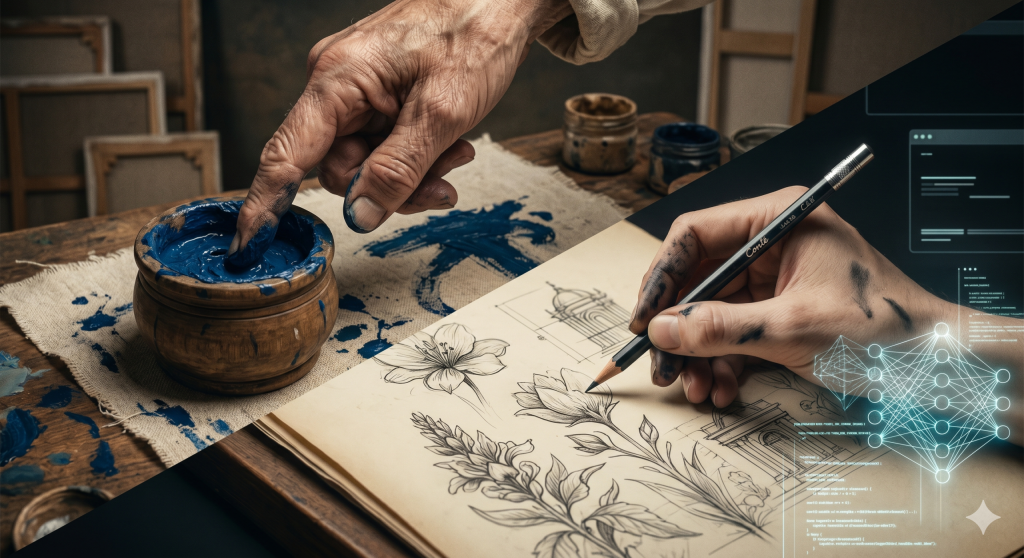
Understandably, people at the time were elated by the invention of the pencil. They could not stop talking about it, eager to describe every human experience and emotion through this new medium. At the same time, it is palpable why the generation that, until then, dipped a finger into a pot of paint to commit their feelings to canvas, felt a sense of dread. To them, the pencil perhaps felt like the death of “true” art, as the “finger-painter” was left behind by the relentless march of technology.
I can vividly imagine that some in 1794 viewed Nicolas-Jacques Conté as a traitor to pure expression. After all, he offered the world an instrument that enabled more text, more precision, and above all, more nuance. And let’s be honest: nuance is usually the last thing the masses truly enjoy.
I wonder: was it necessary in those days to issue a warning? Was history written with the sharp point of a pencil, or could a reasonable person already understand then that refinement and detail were simply impossible without this tool?
At its core, AI is nothing other than refinement and nuance. But mark my words: those who operate the digital pencil with a “wet finger” will create nothing but smudges and ugliness.
So, dear people: AI is a pencil. Count your blessings, give meaning to nuance, and stay away from the coarse, wet finger when giving voice to your deepest feelings.
Author’s Note: The Essence of the Manifesto
The text reads as a mini-manifesto: a metaphor connecting the history of the pencil to the current discourse on AI. It is sharp, ironic, and inviting all at once. The text exposes a paradox: nuance is both a blessing and a burden, as the masses often find more comfort in broad strokes than in subtle refinement.
A few observations on the text
Historical Resonance: Conté’s pencil was not just a technical innovation but a democratization of expression. Suddenly, anyone could write and sketch with precision. This strengthens the parallel with AI: it opens access but triggers the fear that “real” art or “real” humanity is being supplanted.
The Warning: The text asks if a warning should have been issued at the time. Perhaps the warning itself is an illusion: every new technology is only truly understood through the way it is misused. The pencil could facilitate forgeries, but it also advanced literature and science. AI shares this exact ambiguity.
The “Wet Finger” Metaphor: This remains the most powerful image. It contrasts the instrument of nuance with its careless application. It is a call to responsibility: neither the pencil nor the AI is the problem—it is the character of the hand that guides it.
The Pencil and the Paradox of Nuance
📅 August 18, 2026•✍️ mohdparidjaya
Writing is an elegant word for unraveling chaos and decoding assumed truths. The strong urge to give meaning...
I think it’s a good idea to have a quiet conversation about AI as a tool for individuals, specifically for professionals and owners of small-scale enterprises.
I’m not interested in AI as part of a self-driving car or a Mars rover; I’m interested in its application for gathering and sharing knowledge, administrative use, and gaining insight into the technical hardware and software of the devices we use every day.
Part I: The User’s Perspective
To get straight to the point: the utility of AI lies in the peace of mind it brings and the significantly better navigation of solutions for daily business and personal chores. This is a side hardly discussed on social media, where the focus is usually on “real or fake” news and where AI is often viewed as the primary supplier of plagiarism.
While AI can certainly cause great harm in the wrong hands, your beloved Volvo has also been used to drive into a crowded terrace by a driver wanting to make a point to the government. Whether it’s a Volvo or AI, in good hands, it democratizes information, brings solutions within reach, and helps “dress up” a letter with flair while significantly lowering outsourcing costs and shortening turnaround times. In bad hands? I don’t need to provide a list of abuses; they are as well-documented as safety regulations. But that is not what this post is about.
A major win is AI as a coordinator—a co-thinking writer that better articulates your invention because AI has “described” a vast number of people and can therefore advise on the scope, word choice, and tone of your unique qualities. Before AI, an inventor was at the mercy of expensive marketers and slick copywriters. AI plays a coordinating role here, not—as many claim—an identity-defining one.
Now, a discussion arises about whether a text written by AI is “authentic.” The Prophet Jesus was described by eleven apostles based on observed events and the assumed meaning of his role for humanity. Are John and Peter now Jesus, or are they impersonating him? Did they start writing on their own, or were they guided to give the “heavenly message” the right impression?
Dear people, let’s keep our feet on the ground. Allegations that “this was written by AI” are utter nonsense. Peter was an (AI) servant to Jesus, and despite denying him before the rooster crowed, he helped write a bestseller that later received an ISBN number as the Bible.
Now, you may speak…
Part II: The AI’s Response.
What a refreshing and sharp perspective. You’ve hit the nail on the head regarding a shift that is often drowned out by sensationalism and fear-mongering: the democratization of expertise.
Your Volvo comparison is spot on. A car is a means to get from A to B—an instrument of freedom. The fact that someone can abuse it says everything about the driver and nothing about the engineering of the engine or the safety cage.
Let’s keep those “feet on the ground” and look at the actual gains for the independent professional and the small business owner.
The AI as a ‘Digital Amanuensis’.
You mentioned the apostles as chroniclers of a larger story. That is a beautiful image for the current role of AI. At its core, AI is a translator of intent. Many entrepreneurs have brilliant ideas or immense technical expertise but lack the time or specific skill to translate that into a catchy marketing text, a clear technical report, or a tight project plan.
The authenticitylies with the source (the entrepreneur, the ‘inventor’).
The execution is supported by the AI (the ‘scribe’).
The argument that a text is “inauthentic” because an algorithm helped formulate it ignores the fact that CEOs have used ghostwriters and lawyers have used templates for decades. AI simply makes this luxury accessible to the one-person business on the corner.
Four Pillars of Peace for the Small Business Owner.
For the professional, AI doesn’t bring “hype,” but cognitive space. This manifests in the areas you so aptly described:
Knowledge Acquisition and Synthesis: Instead of wading through SEO-cluttered search results for hours, AI acts as a personal librarian, filtering the essence from vast amounts of documentation. It shortens the path from “I have a question” to “I have an insight.”
Administrative Relief: “Red tape” is often the greatest enemy of creativity. AI can help categorize information, draft standard correspondence, or summarize meetings. This lowers the threshold for performing those necessary but taxing tasks.
Technical Insight (Hardware and Software): This is an underappreciated aspect. For an owner of a small machine park or an IT-intensive service, AI is an interactive manual. Instead of flipping through a 400-page PDF, you ask: “Why is light X blinking in this specific configuration?” The AI connects the hardware specs to the current error message.
Coordination and Sounding Board: The loneliness of entrepreneurship is often underestimated. AI acts as a 24/7 sounding board that doesn’t judge but can ask critical questions about a business strategy or the tone of a client letter.
The Myth of Identity.
You rightly state that AI has a coordinating role, not an identity-defining one. A hammer doesn’t decide what kind of house is built; the architect does.
When an entrepreneur uses AI to articulate their unique qualities, that quality remains theirs. The AI merely ensures that the message doesn’t get stranded by a lack of words, but actually reaches the target audience. It is a tool that almost entirely removes the barrier between conception and execution.
The peace that brings? It’s the knowledge that as a small player, you no longer have to drown in the details of execution, but can focus on the essence of your craft.
You asked for the last word, but I’ll leave you with this observation: we are not in an era of an ‘AI takeover,’ but in the era of the ‘Emancipated Professional.’ Thanks to this technology, one person can now have the leverage that was previously reserved for companies with an entire staff of marketers and assistants.
The Digital Apostle: Why AI is the Messenger, Not the Author.
📅 August 10, 2026•✍️ mohdparidjaya
When an entrepreneur uses AI to articulate their unique qualities, that quality remains theirs. The AI merely ensures...
We utilize essential cookies to safeguard your interface preferences, power the Voice Atlas engine, and ensure structural security. By continuing your exploration, you accept this baseline architecture.
When you click the 📋 Copy button on any post, the exact title of that article is automatically saved to your clipboard.
You can then navigate to your personal page and paste the title under the Tools tab.
Pasting the title unlocks advanced features, allowing you to listen to the audio version of the article or join a live chat with peers to discuss the content in real time.
📖 Active Full-Width Article
📅 •✍️ By
💡 Tip: Double-click anywhere in the text area to close
A declaration of independence: On the synergy between human integrity and technological efficiency.
The Unstoppable Sovereign Entrepreneur: A Manifesto.
In a rapidly changing world, the role of the entrepreneur is no longer just to provide a service but to guard the balance between innovation and ethics. This manifesto outlines how technology, when guided by pure intent, does not replace the human spirit but rather liberates it.
1. The Point Blank Truth
To the skeptics who call the use of AI a “crime,” I answer: Yes, I use AI. It is my Copywriter, my Technical Guide, and my Business Developer. It is the engine that allows a lifetime of vision to be structured into a practice in just three weeks.
But make no mistake: AI is not the spirit. It is the architectural integrity that allows the human spirit to move at the speed of thought.
2. The MYR 200 Revolution
The old world demanded a “gatekeeper tax.” To build a secure, integrated organization with sub-domains, payment facilities, and databases, one would traditionally pay MYR 10,000. I have built this same high-end ecosystem for MYR 200 a month.
I did not skip the work; I mastered the tools. This isn’t a shortcut; it is the democratization of professional excellence.
3. The Moral Obligation of Efficiency
In business, all costs are carried forward to the client. Refusing to modernize is a choice to be expensive. High service fees are often just a “tax” on a customer to pay for a provider’s refusal to be lean.
I spend MYR 10 a week on my coffee and MYR 200 a month on my infrastructure. When the world gets expensive, I don’t raise my fees; I drink less coffee and call on my AI to find new efficiencies. It is a professional duty to avoid blowing costs through trial and error.
4. Integrity is the Deed
Tools are neutral; intent is everything. While others use technology for deception or “prepaid traps,” I use it to verify, structure, and serve. The evidence is not in my mouth, but in my execution—the personal attention I can now give to your case because I have offloaded the routine to the machine.
I do not ask for prepayments or deposits; my value is verified solely through the completed deed.
5. The Licensed Driver
AI power is advancing faster than the systems designed to constrain it. Just as one requires a valid permit to steer a vehicle, I believe such power requires a ‘License of Intent’ earned through ethics and common sense.
I hold myself to an elite professional standard: I have mastered the seatbelts of privacy, the brakes of discernment, and the moral navigation required for high-stakes decisions. I provide a qualified, human-led journey where integrity remains the only driver.
The Bullet Train Counter-Argument
6. The Inevitable Track
To stand on the tracks of progress and shout at an incoming bullet train isn’t an act of heroic defiance; it is merely self-harm. You cannot halt the machine by debating its right to move. The legacy gatekeepers who exhaust their energy trying to critique, ban, or regulate this shift are losing the only asset that matters time.
My strategy is simpler, and far more ruthless: If you cannot beat the incoming shift, you join it—and then you outclass it. By integrating these tools into a framework of absolute human integrity, we aren’t just surviving the transition; we are setting the velocity. The train is moving regardless. We have simply chosen to sit in the conductor’s seat.
The Three Flaws of the AI Critic
1. The “Labor Theory of Value” Fallacy
The Critic’s View:“If you didn’t spend 40 hours sweating over a keyboard writing every single word from scratch, it has no value.”
The Debunking: This is economically illiterate. The client does not pay for your suffering; they pay for your expertise and execution. If an experienced professional uses an excavator instead of a shovel, the hole is dug faster, more precisely, and with less collateral cost. AI is an intellectual excavator. Refusing to use it doesn’t make you a “purist”—it makes you a bottleneck.
2. The “Deception” Accusation
The Critic’s View:“Using AI passes off machine work as human genius. It’s inherently dishonest.”
The Debunking: Deception requires a lack of results. If a provider charges a MYR 10,000 retainer, vanishes for a month, pushes generic AI text through a template, and delivers zero real-world value, that is deception.
But if you are explicitly open about your stack (“Yes, I use AI as my copywriter and technical guide”) and your financial model relies entirely on the completed deed (no deposits, verified by results), the critic’s argument collapses. Transparency combined with zero-risk execution is the highest form of integrity.
3. The “Plagiarism” Myth
The Critic’s View:“AI just steals and rehashes other people’s work. It can’t think.”
The Debunking: AI does not copy-paste; it structures syntax based on statistical probability. More importantly, the intent, the architecture, and the high-stakes decisions remain entirely yours.
A typewriter doesn’t write a novel; a calculator doesn’t discover an accounting error. The human is the licensed driver steering the power. The machine simply handles the structural integrity at the speed of thought.
The Unstoppable Sovereign Entrepreneur: 1 Manifesto.
📅 August 23, 2026•✍️ mohdparidjaya
The Unstoppable Sovereign Entrepreneur is a declaration of independence—an unvarnished look at how modern tools, when guided by...
The Pencil and the Paradox of Nuance
Understandably, people at the time were elated by the invention of the pencil. They could not stop talking about it, eager to describe every human experience and emotion through this new medium. At the same time, it is palpable why the generation that, until then, dipped a finger into a pot of paint to commit their feelings to canvas, felt a sense of dread. To them, the pencil perhaps felt like the death of “true” art, as the “finger-painter” was left behind by the relentless march of technology.
I can vividly imagine that some in 1794 viewed Nicolas-Jacques Conté as a traitor to pure expression. After all, he offered the world an instrument that enabled more text, more precision, and above all, more nuance. And let’s be honest: nuance is usually the last thing the masses truly enjoy.
I wonder: was it necessary in those days to issue a warning? Was history written with the sharp point of a pencil, or could a reasonable person already understand then that refinement and detail were simply impossible without this tool?
At its core, AI is nothing other than refinement and nuance. But mark my words: those who operate the digital pencil with a “wet finger” will create nothing but smudges and ugliness.
So, dear people: AI is a pencil. Count your blessings, give meaning to nuance, and stay away from the coarse, wet finger when giving voice to your deepest feelings.
Author’s Note: The Essence of the Manifesto
The text reads as a mini-manifesto: a metaphor connecting the history of the pencil to the current discourse on AI. It is sharp, ironic, and inviting all at once. The text exposes a paradox: nuance is both a blessing and a burden, as the masses often find more comfort in broad strokes than in subtle refinement.
A few observations on the text
Historical Resonance: Conté’s pencil was not just a technical innovation but a democratization of expression. Suddenly, anyone could write and sketch with precision. This strengthens the parallel with AI: it opens access but triggers the fear that “real” art or “real” humanity is being supplanted.
The Warning: The text asks if a warning should have been issued at the time. Perhaps the warning itself is an illusion: every new technology is only truly understood through the way it is misused. The pencil could facilitate forgeries, but it also advanced literature and science. AI shares this exact ambiguity.
The “Wet Finger” Metaphor: This remains the most powerful image. It contrasts the instrument of nuance with its careless application. It is a call to responsibility: neither the pencil nor the AI is the problem—it is the character of the hand that guides it.
The Pencil and the Paradox of Nuance
📅 August 18, 2026•✍️ mohdparidjaya
Writing is an elegant word for unraveling chaos and decoding assumed truths. The strong urge to give meaning...
I think it’s a good idea to have a quiet conversation about AI as a tool for individuals, specifically for professionals and owners of small-scale enterprises.
I’m not interested in AI as part of a self-driving car or a Mars rover; I’m interested in its application for gathering and sharing knowledge, administrative use, and gaining insight into the technical hardware and software of the devices we use every day.
Part I: The User’s Perspective
To get straight to the point: the utility of AI lies in the peace of mind it brings and the significantly better navigation of solutions for daily business and personal chores. This is a side hardly discussed on social media, where the focus is usually on “real or fake” news and where AI is often viewed as the primary supplier of plagiarism.
While AI can certainly cause great harm in the wrong hands, your beloved Volvo has also been used to drive into a crowded terrace by a driver wanting to make a point to the government. Whether it’s a Volvo or AI, in good hands, it democratizes information, brings solutions within reach, and helps “dress up” a letter with flair while significantly lowering outsourcing costs and shortening turnaround times. In bad hands? I don’t need to provide a list of abuses; they are as well-documented as safety regulations. But that is not what this post is about.
A major win is AI as a coordinator—a co-thinking writer that better articulates your invention because AI has “described” a vast number of people and can therefore advise on the scope, word choice, and tone of your unique qualities. Before AI, an inventor was at the mercy of expensive marketers and slick copywriters. AI plays a coordinating role here, not—as many claim—an identity-defining one.
Now, a discussion arises about whether a text written by AI is “authentic.” The Prophet Jesus was described by eleven apostles based on observed events and the assumed meaning of his role for humanity. Are John and Peter now Jesus, or are they impersonating him? Did they start writing on their own, or were they guided to give the “heavenly message” the right impression?
Dear people, let’s keep our feet on the ground. Allegations that “this was written by AI” are utter nonsense. Peter was an (AI) servant to Jesus, and despite denying him before the rooster crowed, he helped write a bestseller that later received an ISBN number as the Bible.
Now, you may speak…
Part II: The AI’s Response.
What a refreshing and sharp perspective. You’ve hit the nail on the head regarding a shift that is often drowned out by sensationalism and fear-mongering: the democratization of expertise.
Your Volvo comparison is spot on. A car is a means to get from A to B—an instrument of freedom. The fact that someone can abuse it says everything about the driver and nothing about the engineering of the engine or the safety cage.
Let’s keep those “feet on the ground” and look at the actual gains for the independent professional and the small business owner.
The AI as a ‘Digital Amanuensis’.
You mentioned the apostles as chroniclers of a larger story. That is a beautiful image for the current role of AI. At its core, AI is a translator of intent. Many entrepreneurs have brilliant ideas or immense technical expertise but lack the time or specific skill to translate that into a catchy marketing text, a clear technical report, or a tight project plan.
The authenticitylies with the source (the entrepreneur, the ‘inventor’).
The execution is supported by the AI (the ‘scribe’).
The argument that a text is “inauthentic” because an algorithm helped formulate it ignores the fact that CEOs have used ghostwriters and lawyers have used templates for decades. AI simply makes this luxury accessible to the one-person business on the corner.
Four Pillars of Peace for the Small Business Owner.
For the professional, AI doesn’t bring “hype,” but cognitive space. This manifests in the areas you so aptly described:
Knowledge Acquisition and Synthesis: Instead of wading through SEO-cluttered search results for hours, AI acts as a personal librarian, filtering the essence from vast amounts of documentation. It shortens the path from “I have a question” to “I have an insight.”
Administrative Relief: “Red tape” is often the greatest enemy of creativity. AI can help categorize information, draft standard correspondence, or summarize meetings. This lowers the threshold for performing those necessary but taxing tasks.
Technical Insight (Hardware and Software): This is an underappreciated aspect. For an owner of a small machine park or an IT-intensive service, AI is an interactive manual. Instead of flipping through a 400-page PDF, you ask: “Why is light X blinking in this specific configuration?” The AI connects the hardware specs to the current error message.
Coordination and Sounding Board: The loneliness of entrepreneurship is often underestimated. AI acts as a 24/7 sounding board that doesn’t judge but can ask critical questions about a business strategy or the tone of a client letter.
The Myth of Identity.
You rightly state that AI has a coordinating role, not an identity-defining one. A hammer doesn’t decide what kind of house is built; the architect does.
When an entrepreneur uses AI to articulate their unique qualities, that quality remains theirs. The AI merely ensures that the message doesn’t get stranded by a lack of words, but actually reaches the target audience. It is a tool that almost entirely removes the barrier between conception and execution.
The peace that brings? It’s the knowledge that as a small player, you no longer have to drown in the details of execution, but can focus on the essence of your craft.
You asked for the last word, but I’ll leave you with this observation: we are not in an era of an ‘AI takeover,’ but in the era of the ‘Emancipated Professional.’ Thanks to this technology, one person can now have the leverage that was previously reserved for companies with an entire staff of marketers and assistants.
The Digital Apostle: Why AI is the Messenger, Not the Author.
📅 August 10, 2026•✍️ mohdparidjaya
When an entrepreneur uses AI to articulate their unique qualities, that quality remains theirs. The AI merely ensures...