All Paper Trails
🏛️ All Articles
🏷️ AI Experiences 5
🏷️ Culture 6
🏷️ Digital Well-being 5
🏷️ Festive 6
🏷️ Labels 1
🏷️ Mental Health 2
🏷️ News Reflections 4
🏷️ philosophy 3
🏷️ Politics 2
🏷️ Relationships 2
🏷️ Satire 1
🏷️ Teasers 3
💡 How to Listen & Discuss Articles ▼ Instructions
When you click the 📋 Copy button on any post, the exact title of that article is automatically saved to your clipboard.
You can then navigate to your personal page and paste the title under the Tools tab.
Pasting the title unlocks advanced features, allowing you to listen to the audio version of the article or join a live chat with peers to discuss the content in real time.
📖 Active Full-Width Article
📅
•
✍️ By
💡 Tip: Double-click anywhere in the text area to close
Soldiers Need the Value of the Flag, Not Political Farts.
“This is not a story about a hidden cabal, but about visible incentives, public bargains and structural moral hazard that politicians would rather you didn’t connect.”
“Parents failed to teach their children well, and now a new generation has to teach its parents – and their politicians – what responsibility, memory, and restraint are supposed to mean in geopolitics.”
“A man once marketed as ‘Teflon Mark’ and ‘Trump whisperer’ now presides over a moral economy where failure never sticks, but new power and a ‘freedom tax’ do. For soldiers with a McRaven‑like sense of duty, it’s hard to watch: the people who dodged responsibility at home now sell redemption to Trump and NATO abroad, paid for by civilians and executed by soldiers. That is how you manufacture moral injury in uniform: you ask men and women to bleed for principles that their own leaders treated as disposable in peacetime – and suddenly rediscovered when a ‘freedom tax’ and a NATO promotion were on the table.”
“It is easy to bash Rutte, but even he operates in an arena that increasingly resembles a bumper‑car hall without rules: no credible frames, no guardrails, no neutral referees. In such an environment, where the UN is paralyzed, and great powers treat norms as optional, almost anyone can be turned into a witch or a warlord by the logic of the game. That does not absolve leaders of responsibility – it makes their moral choices more, not less, decisive.”
1. War tax as a power in politics
“The so‑called ‘freedom tax’ is not a spontaneous act of civic virtue; it is the fiscal residue of a power bargain between Trump and Rutte. Under Trump’s relentless pressure for higher NATO spending, European leaders – meeting in the Netherlands and cheered on by NATO secretary‑general Rutte – pledged massive increases in defense budgets, which the new Dutch government now tries to translate into a ‘war tax’ on citizens’ income. It is pure power politics dressed up as shared sacrifice.”
“Europe’s new defense money functions like an indulgence paid to Trump: an EU ‘freedom tax’ at home buys tariff relief and goodwill in Washington, while giving the U.S. extra fiscal room to pick fights elsewhere – from Iran to Cuba to whatever next Greenland‑style adventure catches the mood in the Oval Office. Rutte, now Trump’s preferred NATO interpreter, sells this as responsible burden‑sharing, but in practice, Europe is financing an American foreign‑policy casino it doesn’t control.”
2. Failed diplomats as war staff
“War is the product of failed diplomacy. If the very diplomats and politicians who let diplomacy fail then proceed to design the war, levy a ‘war tax’ and send soldiers out, you’ve created a closed loop of irresponsibility. The arsonist is now also the fire chief. Before you burden citizens with new taxes and ask soldiers to die for it, those who failed at the diplomatic stage should step aside and hand the stick to others.”
3. McRaven‑minded soldiers vs Teflon politicians
“For soldiers shaped by the ethos McRaven describes – discipline, quiet courage, doing the hard thing when no one is watching – this new ‘war leadership’ must feel like a sham. They train to carry real risk, while the people who failed at prevention now posture as commanders‑in‑chief of a conflict they never truly understood. The language of sacrifice is coming from mouths that have sacrificed almost nothing themselves.”
“That is how you manufacture moral injury in uniform: you ask men and women to bleed for principles that their own leaders treated as disposable in peacetime – and suddenly rediscovered when a ‘freedom tax’ and a NATO promotion were on the table.”
4. Ukraine, NATO and the US arms industry
“NATO fortifying its own territory doesn’t trigger a world war; it’s a theatre with real hardware but limited meaning. What turned irritation into invasion was Europe’s attempt to lock Ukraine into its own sphere of influence – economically via Brussels, militarily via NATO pipelines. For Putin, a stronger NATO inside its old borders was noise; losing Ukraine for good was casus belli. The outcome now looming is a disguised partition: a frozen front, a truncated Ukraine and a NATO that talks tough at the edges while normalizing Russia’s Donbas demands in practice.”
“At the same time, Europe’s rearmament and new defense levies pour billions into a market where a huge slice of spending ends up with U.S. arms companies; analyses already show that European defense outlays heavily favor American suppliers. Tariffs have been rebranded as a war tax, and still, it’s never enough. It’s the Chamberlain drama in a remake – not with a piece of paper in Munich, but with tax bills in our mailboxes and McRaven‑type soldiers sent to tidy up the mess.”
5. Europe’s self‑undermining experiment
“In just over a century, Europe has managed to make itself look ridiculous twice: first by tearing itself apart in two world wars, and now by sleepwalking into a proxy war on its own doorstep – squandering lives, infrastructure and cultural heritage, and betraying almost everything the post‑war European experiment claimed to stand for. The pillars of ‘never again’, economic interdependence and a credible rights‑based order are being hollowed out by the very elites who claim to defend them.”
“With all this serious new money, we’re not just arming ourselves, we’re effectively underwriting France – a state with a deeply ambiguous war morality. It feels like signing a mortgage to finance your own crucifixion, with a cast of Pontius Pilate‑types around the table whose only stable instinct is belligerence. Paris loves to point the moral finger at others, while politely omitting what its own Foreign Legion is still doing in the shadows today – from the Sahel to assorted ‘stabilization’ theatres. And yet this is the ecosystem we’re told to trust with a European ‘war tax’: a club that launders its colonial hangovers into lectures on values.”
6. Parents, children and memory
“Parents failed to teach their children well, and now a new generation has to teach its parents – and their politicians – what responsibility, memory and restraint are supposed to mean in geopolitics. Soldiers need the value of the flag – coherent principles, remembered history, accountable leadership – not political gas from leaders who treat war as a branding exercise. If we don’t restore that basic hierarchy of values, we’ll keep asking our children to die for adults who never learned to grow up.”
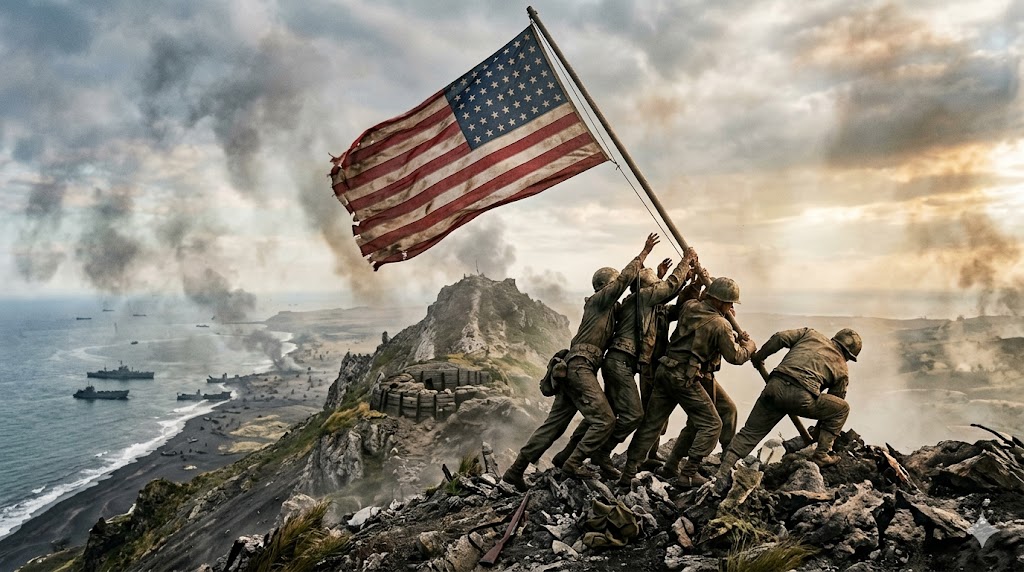
Flag or Fart?
📅 August 8, 2026
•
✍️ mohdparidjaya
Soldiers Need the Value of the Flag, Not Political Farts. “This is not a story about a hidden...
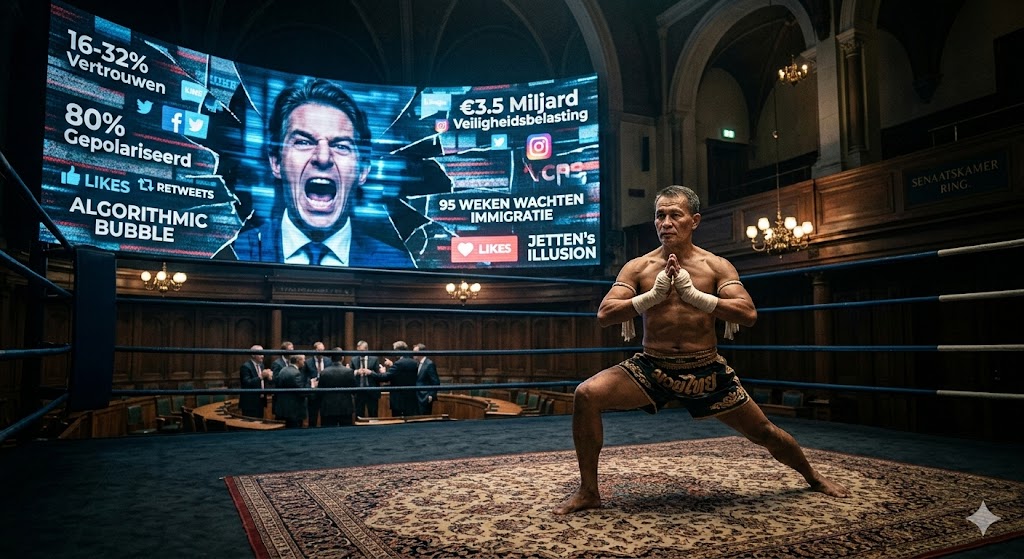
This article examines a global decline into mediocre political representation, using the Netherlands’ representative democracy as its central case study through pointed examples. From Muay Thai’s lost philosophy of respect to dopamine-driven governance, it reveals how core values erode under spectacle and ego.
The Martial Art of Democracy: From Muay Thai Philosophers to Dopamine Politicians
With an Unblinking Stare on Organizational Psychology and Geopolitics.
Muay Thai, as pure martial art rooted in Buddhist discipline and physical transcendence, is not reduced by visionaries like Bruce Lee to merely defeating an opponent through brute force, tactical superiority, or momentary glory, but fundamentally defined by a deep-rooted, mutual respect for the sparring partner as a mirror of one’s own soul—a living, reactive instrument that exposes your stance, timing, intent, and emotional control, so the fight no longer targets flesh and blood, but the hidden limitations of your ego, visible only in the arena’s heat.
The essence lies in voluntary surrender to this confronting learning process: the challenging partner is not an enemy to break or humiliate, but a catalyst for self-development as philosopher in the ring, consciously fueling the challenge and forcing choices that prioritize respect for the art itself—not the illusion of triumph or domination—bringing the challenger to their knees through refined, intuitive positional choice: deftly parrying attacks to assume a dominant yet never destructive stance that preserves mutual growth.
This position intimidates through pure, controlled presence and moral superiority, inflicting no unnecessary harm that undermines reciprocal evolution or reduces it to mere suffering—for the challenger’s true helping hand lies precisely in exposing your loss of self-respect and self-inflicted pain, not through the physical blow itself, but at that crucial psychological moment when you betray the required ground stance—the core of discipline: emotions, driven relentlessly by ego, take over, causing fatal distraction that transforms the art into chaotic, self-destructive madness.
Contemporary Martial Arts: Glory Over Respect
How far has modern martial arts drifted from these primal values of introspection and control, when fame as ultimate trophy, stare-down rituals as psychological intimidation, and inflicting pain as essential sensational show element artificially inflate entertainment value at the cost of dopamine hits for the audience, while inflicting profound, often irreparable damage to character—the moral, psychological core of discipline, humility, and mutual respect—reducing the sport to a caricature of its philosophical origin?
It recalls the biting, prophetic satire in Life of Brian, where a mother and son boredly debate the day’s best spectacle—a bloody lion fight or medieval stoning—a painfully accurate unmasking of how this so-called ‘art,’ once a vehicle of self-transcendence, is rendered utterly ridiculous by the audience’s low, primitive expectations, seeking not personal elevation or collective wisdom, but raw cathartic sensation without reflection.
Politics as a Degenerate Ring: PM Rob Jetten‘s Illusion
Project this distorted, commercialized dynamic onto politics as the ‘art’ of collective governance and conflict resolution, where at best every action, debate, and concession is governed by the described values of respect, emotional control, and mutual growth through failure, and you witness a tragic, recognizable caricature.
Replace Bruce Lee’s transcendental, adaptive ethos with Rob Jetten’s ostensibly sporty daring, the Muay Thai ring with the coveted Chambers of the States General, and the sparring partner with a fragile coalition of opportunism and identity politics.
Jetten, who profiles himself as a boxing enthusiast with ambitious, physically disciplined mindset, seems bitterly ignorant of martial arts’ deeper core as life metaphor—his sharp, confrontational rhetoric, obsessive coalition drive, and focus on visible, measurable ‘wins’ in polls and headlines align seamlessly with promoters keeping the show profitable, not Lee’s timeless principle of “absorb what is useful, reject what is useless,” prioritizing radical adaptation, self-knowledge, and ego release over fleeting dominance.
In 2026, trust in his vulnerable minority cabinet plummets to historic lows (16-32%), while polarization explodes via social media echo chambers and algorithmic bubbles—likes, retweets, and viral clips now fully dictate the political agenda, at the expense of philosophical depth, turning real failure into sustainable growth and institutional resilience.
The decay of governing institutions through all-encompassing dopamine mania of ‘likes,’ shares, and virtual applause creates a toxic bed that fundamentally repels and isolates those imposing self-limits—from deep-rooted preservation of values like mutual respect, discipline, and long-term thinking: no ‘honor to be gained’ in an arena where every interaction, idea, and identity is reduced to monetizable capital, emotional triggers, and superficial alliances.
Democratic DNA: The 1464 Compromise
Strictly technically, modern parliamentary democracy dates to Thorbecke’s liberal Constitution of 1848, institutionalizing ministerial responsibility and basic rights, but to truly diagnose and counter this system’s vulnerability to decay, we must graft its primal DNA to the 15th century: around 1464, with the first meeting of the States General under Burgundian rule in the Low Countries, a proto-democratic compromise emerged between the three pillars of what would become trias politica—church/religion/philosophy as society’s moral and ideological conscience, elite/nobility as hereditary power holder and order protector, and citizen/cities as economic engine and representative voice—where the church, long believing it knew all through divine mandate and infallible doctrine, was forced to cede significant ground in exchange for political and legal protection unavailable elsewhere in Europe, while the bourgeoisie with growing wealth and urban power compelled structured consultation and rudimentary power separation.
This ‘rediscovered respect’ amid dire failure circumstances—religious schisms, Habsburg wars, economic crises—formed the psychological and institutional basis for representative governance: no absolute dominance, but mutual concessions enabling welfare development. Today’s bourgeoisie ignores this DNA, caricaturing trias into polarization.
Generational Choice for Mediocrity
The Netherlands overflows with data, yet the ruling generation consciously chooses low-level polarization (80% experiences division), corrupted algorithms, and likes over nuance. High level remains isolated; mediocre ‘martial arts’ thrives in bubbles.
What more to say?
When you look at it through the lens of Desidarius Erasmus, a few things become painfully clear:
1. The Erasmian Irony of “Voter as Government”
If each voter is a micro-reflection of the government, and the government is the macro-sum of the voters, then the decay described in the article isn’t a top-down imposition. It’s an echo chamber. Erasmus’s Praise of Folly was all about how society willingly embraces illusions because reality is too uncomfortable.
- We claim we want serious governance, but our collective data footprint, our algorithmic clicks, and our votes reward the “dopamine politicians.”
- If the chamber is a circus, it’s because the market for circus tickets is booming.
2. Sidelining Science for “Applied Science”
The point about bending the knee to globalism and allowing “applied science” to sideline pure science is a crucial nuance.
- Pure science requires the same discipline as the classical martial artist: sitting with uncertainty, rigorous self-correction, admitting when you are wrong, and playing the long game.
- Applied science (in the political context) is often weaponized science. It’s data parsed through a consulting firm to justify a pre-determined policy, or a technocratic metric used to quieten debate. It’s “science” turned into a management tool to handle globalist supply chains and macro-demographics, stripped of its philosophical integrity.
3. The Theater Ticket as the Ultimate Tax Cop-Out
This is the most bitter joke of all. When citizens completely lose faith that the Tweede Kamer (Chambers) can actually solve systemic crises—housing, climate, inflation—the psychological contract changes:
The Old Contract: I pay taxes, you provide structural societal solutions. The New Contract: I pay taxes, nothing changes, so I might as well enjoy the screaming match on my timeline.
The tax money effectively becomes a theater subscription fee. If Rob Jetten or any other politician trips up, gets caught in a viral gaffe, or a coalition collapses, it’s no longer viewed as a tragedy for statecraft—it’s viewed as a season finale.
By treating politics as a soap opera, the public gains a sense of cynical superiority (“See? I knew they were all corrupt/incapable anyway”), but they forfeit the very soul of the democratic experiment. It’s a total abdication of the 1464 DNA, where real, structural skin-in-the-game forced people to compromise. Today, if the ship is sinking, at least the light show is spectacular.
It begs the question: if the electorate has fully transitioned from stakeholders to a theater audience, can a system built on mutual respect and “sparring” ever actually be rebooted? Or is the dopamine loop simply too addictive to break?
I conclude with a minimalist stand ‘ Consensus over Selfies’ for decennia the hallmark of ‘Dutch Politics of the polder’.
For decades, the entire hallmark of Dutch politics was the quiet, unglamorous art of consensus. It was born out of literal survival—if the pillars of society (whether the Church, Nobility, and Bourgeoisie in 1464, or the Catholics and Socialists of the 20th century) didn’t sit down and cooperatively drain the water, the entire country would drown. It required stripping away the ego, closing the doors, and making painful, pragmatic compromises for the collective good.
And we traded it for the selfie.
The front-facing camera is the absolute engine of the “dopamine politician.” It requires no long-term vision, no structural concessions, and no deep historical stance. It only requires a ring-light, an curated smile, and a viral quote-tweet to score quick, tribal points inside an algorithmic bubble.
The Erasmian Balance Sheet
By merging insights with the article’s core arguments, we are left with a profoundly sharp diagnosis of our current democratic state:
- The Actor Paradox: We have a system where the 150 members of the Tweede Kamer are structurally bottlenecked, drowning in bureaucratic text, and functionally incapable of delivering true oversight or hyper-rapid legislative solutions. Yet, they cling to their seats, attempting to anchor their globalist frameworks into the constitution before the floor drops out beneath them.
- The Tech Disruption: Generative AI can out-produce human policy generation a thousand times over in a single hour. It breaks the old 19th-century illusion that parliament’s primary job is to write text.
- The Audience Betrayal: Because the public intuitively senses this uselessness, the psychological contract has shattered. We no longer pay taxes expecting structural solutions; we pay them like a theater subscription fee to watch the gladiatorial soap opera play out on our timelines.
The Final Round
If democracy is going to survive the collapse of its 19th-century institutional shape, the theater has to stop. The political class cannot continue to hide behind public relations teams and superficial brand management while globalist forces and “applied science” strip the nation of its philosophical sovereignty.
If the historical memory of the Brothers de Witt teaches us anything, it’s that when a technocratic elite insulates itself too deeply within its own legal fortresses—ignoring the raw, visceral realities of the people outside—the crowd eventually stops buying theater tickets. They drag the actors off the stage.
The transition out of this “dopamine ring” won’t be clean. But recognizing the shift from the hard-fought compromise of 1464 to a generation choosing low-level polarization for internet clout is the first step in clearing the arena. The polder is still flooding; it’s time to put down the phones, stop posing for the cameras, and find the ground stance again.
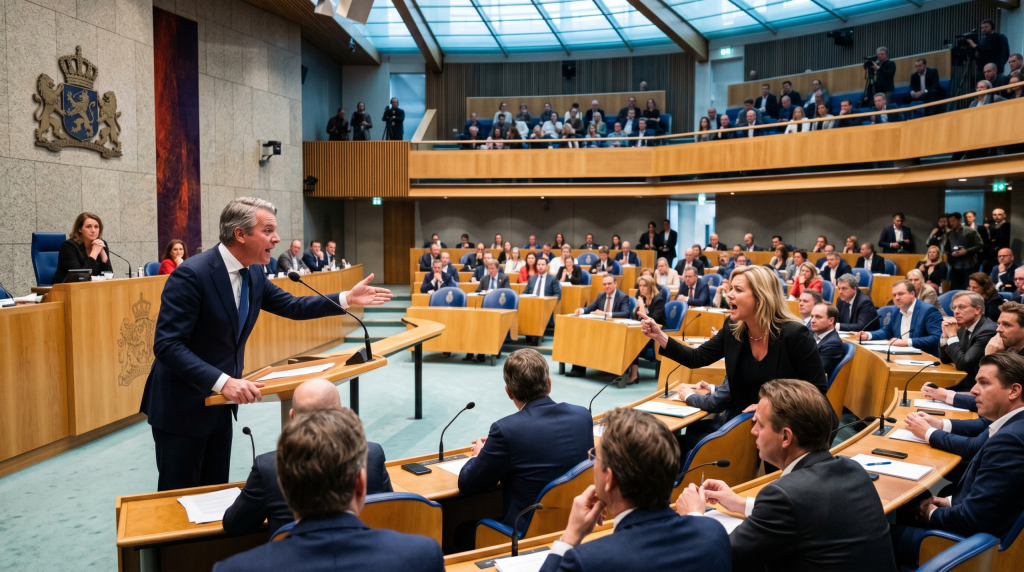
The Martial Art of Democracy
📅 June 15, 2026
•
✍️ mohdparidjaya
The Martial Art of Democracy: From Muay Thai Philosophers to Dopamine Politicians | With an Unblinking Stare on...