When you click the 📋 Copy button on any post, the exact title of that article is automatically saved to your clipboard.
You can then navigate to your personal page and paste the title under the Tools tab.
Pasting the title unlocks advanced features, allowing you to listen to the audio version of the article or join a live chat with peers to discuss the content in real time.
📖 Active Full-Width Article
📅 •✍️ By
💡 Tip: Double-click anywhere in the text area to close
Vissershouding: Rust als Wapen Tegen Digitale Chaos.
Ik zal het moeten toegeven. Eenmaal mijn werkomgeving volledig advertentie- en suggestievrij gemaakt, bekroop mij een gevoel van leegte. Plotseling was ik alleen en moest ik zelf uitvinden wat ik belangrijk vind – waar vind ik het volgende hotel voor mijn vrouw? Een eenmalige zoektocht leidde niet langer tot aanbevelingen voor restaurants, reisverzekeringen of andere ongevraagde rommel. Mijn digitale muur stond zo stevig dat ik het boekje Alleen op een eiland opensloeg en een huisdier adopteerde. Zonder dat een zoekopdracht naar een dierenopvang leidde tot voeradvies of de enge wetenschap van ziektes.
In eerste instantie werd die vermaledijde machine saai. Na het schrijven van een artikel, het regelen van een betaling of het organiseren van mijn gegevens legde ik hem terzijde. Een uitnodiging van een socialemediavriend? Die wacht tot ik er zin in heb. Ik kreeg spontaan selectief geheugenverlies – slapen werd een genot. Geen overstromingen van berichten, geen opgedrongen aanbevelingen. De rust van een oever die op de wal mag vertrouwen en geniet van het uitzicht op stille wateren.
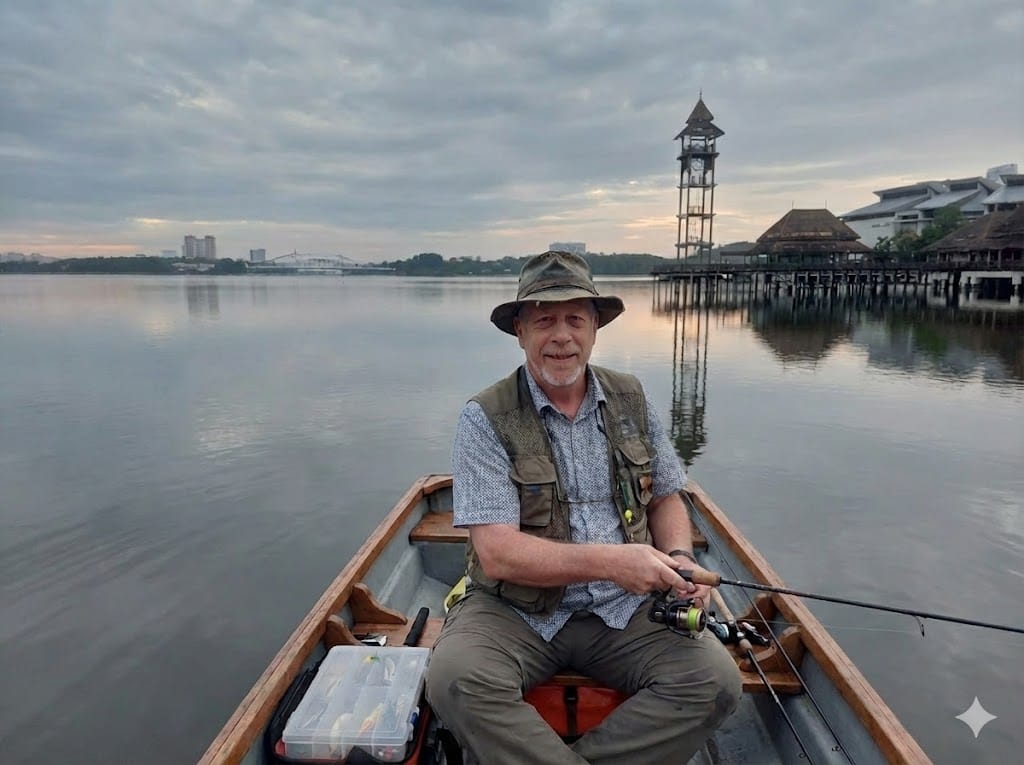
De rust van een visser die weet waar de vissen zwemmen, op welke diepte, met welk aas en in welke houding. Een visser die niet de hele dag jaagt, maar aanwezig is op het water – onder het mom van vissen vangen. Want ‘vissen’ is een hobby die de wereld in een loop brengt: adrenaline – dopamine – apathie, en dan weer hetzelfde ritueel. Juist de uitstraling van kalmte en rust nodigt de zeemeermin uit om te blijven. En die ene zeemeermin geniet van de wal, die het water laat stromen en de oever laat bloeien.
Jaren later ben ik verlost. Ik houd me op de hoogte, maar dit is voor anderen geschreven. Mijn zeemeermin, actief in de hectische marketingwereld – druk, druk, druk – begrijpt nu dat de vissershouding thuis alles relativeert. Relatie doet weer wat ze moet doen: voeden, niet verdrinken.
In een tijd van algoritmes die ons verslaafd maken aan de volgende hit biedt deze houding uitweg. Geen jacht op likes of leads, maar aanwezigheid. Voor leiders, teams en relaties: leg de hengel neer, geniet van het water. De vis komt vanzelf.
#comet als de rustige werkboot op het water,
#perplexity als vismaat die meedenkt,
#echtevrienden als de zeemeerminnen en vissers aan de wal, die maken dat het allemaal ergens over blijft gaan.
De Vissershouding
📅 February 1, 2026•✍️ Editor In Chief
Ik zal het moeten toegeven. Eenmaal mijn werkomgeving volledig advertentie- en suggestievrij gemaakt, bekroop mij een gevoel van...
The Wilhelmus vs. The Straitjacket: Why the Dutch Won’t Be Dictated To.
Focus: The clash between historical self-determination and modern global regulations. Date: February 16, 2026 | 🦁 4 min read
There is a memory deeply etched into the Dutch collective consciousness: a memory of a time when citizens could no longer recognize themselves in the systems that ruled them.
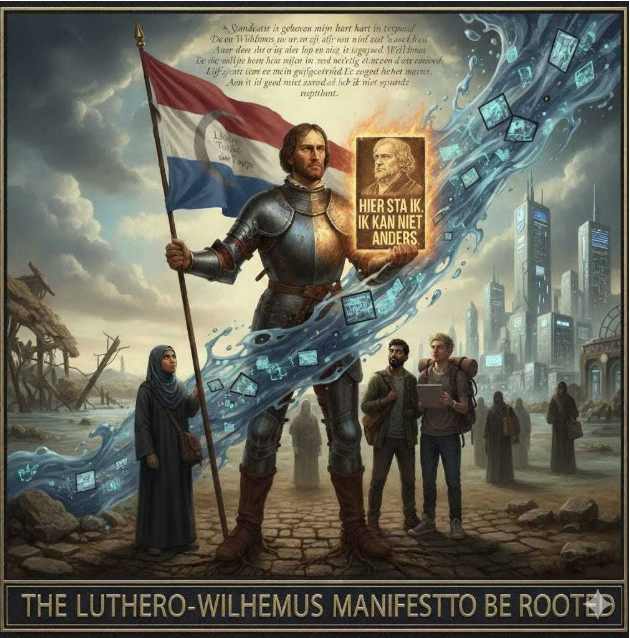
In the seventeenth century, when the Low Countries were dominated by Spain, a fundamental clash arose between a distant, centralizing empire and the local “street.” The lesson of the Eighty Years’ War is simple: The Dutch cannot be bullied endlessly. We stood up for our identity then, and today we face a similar pressure—not from armies, but from abstract globalism.
The Unofficial Anthem
While the Wilhelmus is our official anthem, there is a modern “loud song” that captures the current mood perhaps even better. It is the chorus of 15 Million People:
“15 million people on this very small piece of earth, you don’t dictate the laws to them, you respect their value… they shouldn’t be in a straitjacket, you respect them.”
The Straitjacket of Globalism
Europhiles and politicians in The Hague would do well to listen to those lyrics again. There is a growing tendency to place “international agreements” above the “smallest element.”
The smallest element is the citizen of all ages. When that element is ignored, the structure begins to crack. We see this disconnect everywhere:
The Farmer: Nitrogen targets and trade agreements feel like the sacrifice of a way of life for a spreadsheet in Brussels.
The Entrepreneur: Small business owners are suffocating under European regulations designed for multinationals.
The Neighborhood: In the reception of refugees, local carrying capacity often conflicts with international treaty obligations.
A Return to Reality
The Dutch tradition is one of “poldering” (consensus-seeking), but also of fierce independence. We do not like the straitjacket. Policy only works if it aligns with the daily reality of people, not if it is forced down from a “cold cathedral” of bureaucracy.
Let us respect the smallest element. Because if history teaches us anything, it is that the people on this small piece of earth will eventually push back.
In the seventeenth century, when the Low Countries were dominated by Spain, a fundamental clash arose between a...
Live your Life: The Weight of a Name. Why André Hazes Jr.’s Plea for Silence is Universal.
Inherited legacy, public judgment, and the psychological necessity of private space.
To be born a “Hazes” in the Netherlands is to be born public property. You are the son of a folk legend, an icon, a man whose voice is woven into the DNA of the country. But before the tabloids and the headlines, there is just a human being trying to figure it out.
In 2010, on his album Anders, André Hazes Jr. released a track that felt less like a pop song and more like a boundary-setting. “Het is mijn leven” (It’s My Life) is a raw reflection on fame, gossip, and the right to make your own mistakes.
The Fishbowl Existence
The lyrics resonate deeply because they address a turbulence we all feel, even if we aren’t on magazine covers. It touches on three core psychological pressures:
The Gossip: The constant, intrusive question—“What does anyone else have to do with me?”
The Regret: Acknowledging bad choices without letting them define the future.
The Highs and Lows: Accepting that a messy life is still a valid life.
Watch, But Stay Silent
The core of the song is a powerful request. It is a plea for the one thing fame usually steals: Space.
“It’s my life, watch but stay silent… Give people’s love the space.”
It is a striking line. Watch but stay silent. It acknowledges that people will always look—human nature is curious—but it asks for the decency to withhold judgment.
A Song for Everyone
While written from the perspective of a celebrity, the sentiment strikes a chord with anyone who has felt the weight of expectation. Whether it is a judgmental neighbor or a critical colleague, we all have moments where we want to shout: This is my path. Let me walk it.
It is a reminder to respect others’ journeys, even when we don’t understand their destination.
To be born a “Hazes” in the Netherlands is to be born public property. You are the son...
Calypso: De Kapitein en de Troubadour: Een Eerbetoon aan Twee Pioniers
Focus: De synergie tussen Jacques Cousteau en John Denver: een pleidooi voor ecologisch rentmeesterschap. | 🌊 3 min leestijd
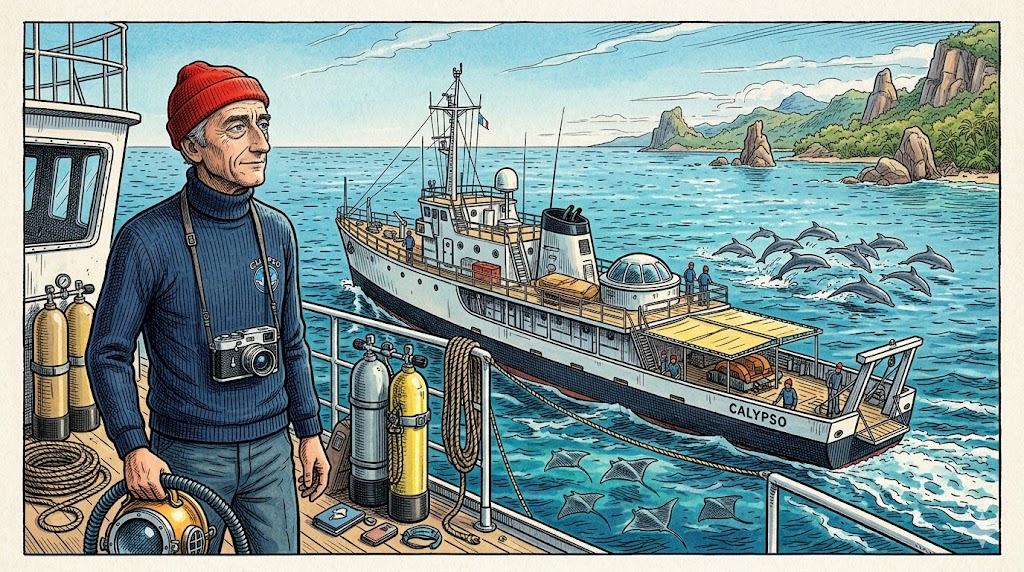
Er was een man met een rode muts, een silhouet tegen de zon, die de grenzen van de stilte overwon waar de diepzee begon. Jacques-Yves Cousteau, de stem van het koraal en het blauw, toonde ons de kwetsbaarheid van de wereld, zijn liefde zo trouw. Met de Calypso als zijn trouwe ros, sneed hij trots door de golven heen, En leerde ons dat we op deze waterplaneet nooit zijn alleen.
En daar, waar de wind door de dennen van Colorado waait, stond een man met een gitaar, door wie de ziel van de bergen werd verraaid. John Denver, dichter van zonneschijn en de rivier, wild en vrij, zong over de schoonheid van het leven, van de bloem tot het tij. Zijn muziek was een kompas, een waarschuwing voor wat we kunnen verliezen, Hij leerde ons de Aarde te koesteren, en niet de hebzucht die we vaak kiezen.
Twee Werelden, Eén Boodschap
Toen de diepzeeduiker en de zanger elkaar op het dek ontmoetten, werd een harmonie geboren die de wonderen van de wereld begroette. Denver bezong de Calypso als een symbool van hoop en licht, terwijl Cousteau de geheimen van de oceaan bracht in het zicht.
Zij waren de bewakers van het groen en het diepe azuur, twee ridders van de wildernis, vechtend voor een toekomst, puur. Vandaag klinkt hun echo nog steeds in het ruisen van de zee en in de ijle lucht van de toppen dragen we hun geesten met ons mee.
De Legacy van de Bewakers
De samenwerking tussen kunst en wetenschap, tussen de gitaar en de duikfles, liet zien dat de taal van de ziel nodig is om de feiten van de wetenschap te laten landen in het menselijk hart. Zonder Cousteau kenden we de diepte niet; zonder Denver voelden we de hoogtes niet.
De synergie tussen Jacques Cousteau en John Denver: een pleidooi voor ecologisch rentmeesterschap.
Flag or Fart: Soldiers Need the Value of the Flag, Not Political Farts.
“This is not a story about a hidden cabal, but about visible incentives, public bargains and structural moral hazard that politicians would rather you didn’t connect.”
“Parents failed to teach their children well, and now a new generation has to teach its parents – and their politicians – what responsibility, memory, and restraint are supposed to mean in geopolitics.”
“A man once marketed as ‘Teflon Mark’ and ‘Trump whisperer’ now presides over a moral economy where failure never sticks, but new power and a ‘freedom tax’ do. For soldiers with a McRaven‑like sense of duty, it’s hard to watch: the people who dodged responsibility at home now sell redemption to Trump and NATO abroad, paid for by civilians and executed by soldiers. That is how you manufacture moral injury in uniform: you ask men and women to bleed for principles that their own leaders treated as disposable in peacetime – and suddenly rediscovered when a ‘freedom tax’ and a NATO promotion were on the table.”
“It is easy to bash Rutte, but even he operates in an arena that increasingly resembles a bumper‑car hall without rules: no credible frames, no guardrails, no neutral referees. In such an environment, where the UN is paralysed, and great powers treat norms as optional, almost anyone can be turned into a witch or a warlord by the logic of the game. That does not absolve leaders of responsibility – it makes their moral choices more, not less, decisive.”
1. War tax as a power in politics
“The so‑called ‘freedom tax’ is not a spontaneous act of civic virtue; it is the fiscal residue of a power bargain between Trump and Rutte. Under Trump’s relentless pressure for higher NATO spending, European leaders – meeting in the Netherlands and cheered on by NATO secretary‑general Rutte – pledged massive increases in defence budgets, which the new Dutch government now tries to translate into a ‘war tax’ on citizens’ income. It is pure power politics dressed up as shared sacrifice.”
“Europe’s new defence money functions like an indulgence paid to Trump: an EU ‘freedom tax’ at home buys tariff relief and goodwill in Washington, while giving the U.S. extra fiscal room to pick fights elsewhere – from Iran to Cuba to whatever next Greenland‑style adventure catches the mood in the Oval Office. Rutte, now Trump’s preferred NATO interpreter, sells this as responsible burden‑sharing, but in practice, Europe is financing an American foreign‑policy casino it doesn’t control.”
2. Failed diplomats as war staff
“War is the product of failed diplomacy. If the very diplomats and politicians who let diplomacy fail then proceed to design the war, levy a ‘war tax’ and send soldiers out, you’ve created a closed loop of irresponsibility. The arsonist is now also the fire chief. Before you burden citizens with new taxes and ask soldiers to die for it, those who failed at the diplomatic stage should step aside and hand the stick to others.”
3. McRaven‑minded soldiers vs Teflon politicians
“For soldiers shaped by the ethos McRaven describes – discipline, quiet courage, doing the hard thing when no one is watching – this new ‘war leadership’ must feel like a sham. They train to carry real risk, while the people who failed at prevention now posture as commanders‑in‑chief of a conflict they never truly understood. The language of sacrifice is coming from mouths that have sacrificed almost nothing themselves.”
“That is how you manufacture moral injury in uniform: you ask men and women to bleed for principles that their own leaders treated as disposable in peacetime – and suddenly rediscovered when a ‘freedom tax’ and a NATO promotion were on the table.”
4. Ukraine, NATO and the US arms industry
“NATO fortifying its own territory doesn’t trigger a world war; it’s a theatre with real hardware but limited meaning. What turned irritation into invasion was Europe’s attempt to lock Ukraine into its own sphere of influence – economically via Brussels, militarily via NATO pipelines. For Putin, a stronger NATO inside its old borders was noise; losing Ukraine for good was casus belli. The outcome now looming is a disguised partition: a frozen front, a truncated Ukraine and a NATO that talks tough at the edges while normalising Russia’s Donbas demands in practice.”
“At the same time, Europe’s rearmament and new defence levies pour billions into a market where a huge slice of spending ends up with U.S. arms companies; analyses already show that European defence outlays heavily favour American suppliers. Tariffs have been rebranded as a war tax, and still, it’s never enough. It’s the Chamberlain drama in a remake – not with a piece of paper in Munich, but with tax bills in our mailboxes and McRaven‑type soldiers sent to tidy up the mess.”
5. Europe’s self‑undermining experiment
“In just over a century, Europe has managed to make itself look ridiculous twice: first by tearing itself apart in two world wars, and now by sleepwalking into a proxy war on its own doorstep – squandering lives, infrastructure and cultural heritage, and betraying almost everything the post‑war European experiment claimed to stand for. The pillars of ‘never again’, economic interdependence and a credible rights‑based order are being hollowed out by the very elites who claim to defend them.”
“With all this serious new money, we’re not just arming ourselves, we’re effectively underwriting France – a state with a deeply ambiguous war morality. It feels like signing a mortgage to finance your own crucifixion, with a cast of Pontius Pilate‑types around the table whose only stable instinct is belligerence. Paris loves to point the moral finger at others, while politely omitting what its own Foreign Legion is still doing in the shadows today – from the Sahel to assorted ‘stabilisation’ theatres. And yet this is the ecosystem we’re told to trust with a European ‘war tax’: a club that launders its colonial hangovers into lectures on values.”
6. Parents, children and memory
“Parents failed to teach their children well, and now a new generation has to teach its parents – and their politicians – what responsibility, memory and restraint are supposed to mean in geopolitics. Soldiers need the value of the flag – coherent principles, remembered history, accountable leadership – not political gas from leaders who treat war as a branding exercise. If we don’t restore that basic hierarchy of values, we’ll keep asking our children to die for adults who never learned to grow up.”
Flag or Fart?
📅 January 7, 2026•✍️ Editor In Chief
Soldiers Need the Value of the Flag, Not Political Farts. “This is not a story about a hidden...
Scientific Satirist
“Morosophos” (The Wise Fool)
PREAMBLE: The Lineage of Risk
Today, I am handing you a tool. It is the only tool that unlocks the trap of the “Yes/No” Discussion—that binary meat-grinder where one side ends up Cancelled and the other ends up Emotionally Disturbed, and nobody learns a damn thing.
We are stuck in a culture of “One Winner Only.” It is a zero-sum game.
To understand why this is a trap, look at the finale of Monty Python’s Life of Brian. Look at the men hanging on the crosses. They are dying. They are doomed. And yet, what are they doing? They are bickering about social placement. They are complaining about being “displaced” or stuck in the “wrong sector.”
They are arguing about their Social Status while being executed.
This is the modern debate. You are fighting for the “Moral High Ground” while the ship is sinking. You are arguing over who has the “better” cross.
Satire is the tool that cuts the rope. It sets you free from the need to “Win” the argument and allows you to simply observe the absurdity of the game.
The Lecture: Compliance vs. Critique
Take a seat.
By now, you have walked through the halls of academia. You have been fed all kinds of theories. You have memorized the manuals of the “Race Theorists” and the “Gender Theorists.” You have been told that you are mastering “Critical Thinking.”
Let us be clear.
What you have been receiving is not Critical Thinking. It is Doctrine.
It is old religious dogmatism dressed in new, secular bottles. It is a script, not a thought process. True critical thinking is dangerous; it dissects everything. What you have learned is merely “Compliance Thinking”—how to repeat the correct slogans to stay safe within the herd. You are soldiers of an ideology you did not write.
Today, we step off that assembly line.
We are entering the Corridors of Power, where the true battle for the mind takes place. And standing there, leaning against the wall, often alone, is Satire.
Satire is the Last Defender
It is the only force left that can set the critical thinker free from the “format”—that rigid mental cage you are forced to adjust to before you are even allowed to think.
It is the only discipline that asks you to look at the Emperor, look at the Mob, and look at yourself, and laugh at the absurdity of it all.
And if you doubt the absurdity of your current situation, consider this:
The Paradox: You are currently living in a system where a critical thinker needs to adjust to a format of critical thinking before their critical thinking is allowed to be considered critical.
The Morosophos Protocol
To survive the 2026 “Blizzard,” the Scientific Satirist follows three rules:
Reject the Binary: When the state demands a “Yes” or “No,” the Satirist provides a “Why?” or a “How Ridiculous.”
Observe the Cross: Never argue with someone about who has the better position on the execution line. Point out the line itself.
Dissect the Doctrine: Treat every “Woke” or “Magistrate” slogan not as a truth, but as a biological specimen. Put it under the microscope. See what it’s made of.
Suggested Reference Library for the Wise Fool
The Blueprint:The Praise of Folly (Erasmus) – The original “Morosophos” text.
The Visual:The Garden of Earthly Delights (Bosch) – To see the chaos for what it is.
The Anthem: “Always Look on the Bright Side of Life” – The song of the man who refuses to be broken by the cross.
Scientific Satirist
📅 January 5, 2026•✍️ Editor In Chief
Satire is the tool that cuts the rope. It sets you free from the need to "Win" the...
‘Sorry’ seems to be the hardest Word
The Signal and the Noise: Why We Need Less “Connectivity” and More Joe Cocker.
Reclaiming human empathy from the debris of the information age.
The Joe Cocker Remedy.
Is there a better way forward? Can we prioritize compassion over the constant, low-level hum of digital rivalry?
Art—and music in particular—offers a powerful lens through which we can re-examine our basic attitudes. As we reflect on how we treat our neighbors, we find the answer in the raw, gravelly vulnerability of the late Joe Cocker. His music reminds us of two things we have largely forgotten in the age of the algorithm: Humility and Courage.
“Sorry Seems to Be the Hardest Word”.
Cocker didn’t just sing; he confessed. The lyrics he made famous encapsulate a longing for connection that we often mask with online bravado:
“What do I have to do to make you love me?”“Sorry seems to be the hardest word to say.”
These aren’t just pop lyrics; they are a challenge. They highlight the difficulty of admitting fault in a culture that rewards being “right” and “loud.”
From Broadcasting to Reconciling.
We can take a cue from this emotional honesty:
Stop Broadcasting: Instead of airing grievances online to an audience of strangers, choose the honest, face-to-face conversation.
Start Apologizing: Offering a sincere apology when we are wrong is not a sign of weakness; it is the ultimate act of strength.
Extend Compassion: Reach out to the isolated. Transform a conflict into an opportunity for growth.
Let us challenge ourselves to listen more attentively and apologize more readily. In doing so, we embrace a new model of connection—one rooted in genuine human empathy rather than mere technological reach.
Listen to the master of vulnerability here:
We live in an era of paradox. We carry devices in our pockets that allow us to connect instantly across continents, yet we often find ourselves drifting further away from true empathy. The fiber-optic cables are working fine, but the human connection is broken.
Despite our unprecedented capacity for communication, humanity is struggling. Interactions are increasingly reduced to competition, exposure, and conflict rather than cooperation and care. We are building bridges of data, but burning bridges of understanding.
This piece strikes a chord that is often drowned out by the “ping” of a notification. It highlights a profound truth: we have perfected the mechanics of contact while neglecting the art of presence.
Joe Cocker is the perfect mascot for this movement because he was the antithesis of the “filtered” life. His performances were messy, spasmodic, and utterly unpolished—which is exactly why they felt so real.
The Contrast: Data vs. Depth.
In the digital age, we’ve traded the “gravel” of human experience for the “silicon” of efficiency. Here is how that trade-off usually looks:
The Digital Signal
The “Cocker” Noise
Curated:Only the best moments.
Raw: The struggle and the sweat.
Defensive:Always being “right.”
Vulnerable:Admitting “I’m wrong.”
Broadcasting: Speaking at people.
Resonating:Feeling with people.
Transactional:What can I get?
Relational:How can I help?
Why “Sorry” is a Superpower.
As the article suggests, the digital landscape is a “no-sorry zone.” To apologize online is often seen as a surrender to the “other side.” But in reality, an apology is a bridge-building tool.
The Bravado Trap: We use screens as shields. It’s easy to be brave when you don’t have to look into the eyes of the person you’ve hurt.
The Strength of Vulnerability: Like Cocker’s voice, a sincere apology is “gravelly.” It’s not smooth or easy, but it carries a weight that a thousand “likes” never will.
Reclaiming the Signal.
The suggestion to move from broadcasting to reconciling is a practical rebellion. If we want to fix the “broken human connection,” we have to be willing to be a little less “connected” to the cloud and a little more tethered to the person sitting across from us. It’s about trading the high-speed fiber optics for the high-impact “I’m sorry.”
If we were to apply the “Cocker Remedy” to our daily digital habits, which one do you think would be the hardest to give up: the urge to “broadcast” your opinion, or the habit of scrolling past the “isolated” in your own circle?
'Sorry' Seems to Be the Hardest Word
📅 January 4, 2026•✍️ Editor In Chief
We live in an era of paradox. We carry devices in our pockets that allow us to connect...
The 1st Step: Why We Leave the Noise Behind.
From algorithms to real humanity. Welcome to a new harbor.
Why We Leave the Noise Behind
The move is complete. My archive is safe, the suitcases are unpacked, and the digital dust cloud from the crossing is settling. Many of you know me from my daily reflections on Facebook. But as I’ve written before: a timeline is fleeting. It’s a marketplace where everyone shouts for attention, while the real conversations often take place in the background.
What can you expect here? On this platform and on my own website, I want to make space for what truly matters. No fleeting “likes,” but:
• Depth in psychology: lessons from 34 years of practical experience with abuse and human behavior. • Geopolitical reflections: looking at the world with an open mind, without the constraints of an algorithm. • The soundtrack of life: why the music of Dylan, Cocker, or Hazes still tells us something about our own soul.
The “Love Boat” As I wrote in my earlier post about Ramadan and Gen Z: we too often find ourselves in the Machinery (the algorithms, the data, the control) while we long for a Love Boat (connection, intimacy, and respect).
This channel is my attempt to crew that “Love Boat.” No intrusive buttons, no blaring ads. Just thoughts on paper. I’m glad you’re here. Let’s see together where the wind takes us.
The 1st Step
📅 January 2, 2026•✍️ Editor In Chief
The move is complete. My archive is safe, the suitcases are unpacked, and the digital dust cloud from...
Happy New Year: Beyond the Noise. The Wind of Mutual Respect in 2026
From digital noise to the human soul: Becoming the ‘wings’ in a world of dust and conflict.
As we stand at the gates of 2026, I know many of you look to this platform for answers. You seek wisdom to break through the ‘Dust’—the dust of conflict we see on the news, the dust of the streets where our neighbors sleep without a roof over their heads, and the digital noise that fills our ears but leaves our hearts empty.
I want to be honest with you: I am not a man who walks on water. I have not flown to the heavens to bring back divine secrets. I am, just like you, merely a traveler standing in the wind.
The Answer is Not Out of Reach.
Sixty years ago, a young poet told us that “the answer is blowing in the wind.” We often misunderstand that, as if the answer is elusive or invisible. But think about what wind actually is. It is precisely what gives an airplane lift. Without wind, the engines just make noise, burn fuel, and go nowhere.
In our lives, Love and Mutual Respect are that wind.
We spend so much time looking down at the dust or up at the clouds for a miracle that we forget to feel the breeze on our faces. The ‘Common Sense’ we so desperately need is not a complex political theory or a new technology. It is the simple, radical act of seeing the person next to us—not as a ghost on the street or a profile on a screen, but as a soul deserving of dignity.
The Call to Action: Becoming the Wing.
As we enter 2026, let us stop trying to ‘acquire’ wisdom as if it were a trophy. Instead, let us try to be the wings that catch the wind.
If there is war, let us be the breath of peace.
If there is coldness, let us be the warmth of a shared roof.
If there is noise, let us be the meaningful silence of a listening ear.
The answers to how many roads a man must walk are not found in law books; they are found in how we treat each other while we walk.
Conclusion: A Wish for the Very Best.
I leave you with the words of that brilliant mind, who reminded us that the truth is all around us if we are only brave enough to feel it. I wish you, your loved ones, and the strangers we have yet to learn to love the very best.
May 2026 be the year we stop making noise and start moving forward.
We utilize essential cookies to safeguard your interface preferences, power the Voice Atlas engine, and ensure structural security. By continuing your exploration, you accept this baseline architecture.
When you click the 📋 Copy button on any post, the exact title of that article is automatically saved to your clipboard.
You can then navigate to your personal page and paste the title under the Tools tab.
Pasting the title unlocks advanced features, allowing you to listen to the audio version of the article or join a live chat with peers to discuss the content in real time.
📖 Active Full-Width Article
📅 •✍️ By
💡 Tip: Double-click anywhere in the text area to close
Vissershouding: Rust als Wapen Tegen Digitale Chaos.
Ik zal het moeten toegeven. Eenmaal mijn werkomgeving volledig advertentie- en suggestievrij gemaakt, bekroop mij een gevoel van leegte. Plotseling was ik alleen en moest ik zelf uitvinden wat ik belangrijk vind – waar vind ik het volgende hotel voor mijn vrouw? Een eenmalige zoektocht leidde niet langer tot aanbevelingen voor restaurants, reisverzekeringen of andere ongevraagde rommel. Mijn digitale muur stond zo stevig dat ik het boekje Alleen op een eiland opensloeg en een huisdier adopteerde. Zonder dat een zoekopdracht naar een dierenopvang leidde tot voeradvies of de enge wetenschap van ziektes.
In eerste instantie werd die vermaledijde machine saai. Na het schrijven van een artikel, het regelen van een betaling of het organiseren van mijn gegevens legde ik hem terzijde. Een uitnodiging van een socialemediavriend? Die wacht tot ik er zin in heb. Ik kreeg spontaan selectief geheugenverlies – slapen werd een genot. Geen overstromingen van berichten, geen opgedrongen aanbevelingen. De rust van een oever die op de wal mag vertrouwen en geniet van het uitzicht op stille wateren.
De rust van een visser die weet waar de vissen zwemmen, op welke diepte, met welk aas en in welke houding. Een visser die niet de hele dag jaagt, maar aanwezig is op het water – onder het mom van vissen vangen. Want ‘vissen’ is een hobby die de wereld in een loop brengt: adrenaline – dopamine – apathie, en dan weer hetzelfde ritueel. Juist de uitstraling van kalmte en rust nodigt de zeemeermin uit om te blijven. En die ene zeemeermin geniet van de wal, die het water laat stromen en de oever laat bloeien.
Jaren later ben ik verlost. Ik houd me op de hoogte, maar dit is voor anderen geschreven. Mijn zeemeermin, actief in de hectische marketingwereld – druk, druk, druk – begrijpt nu dat de vissershouding thuis alles relativeert. Relatie doet weer wat ze moet doen: voeden, niet verdrinken.
In een tijd van algoritmes die ons verslaafd maken aan de volgende hit biedt deze houding uitweg. Geen jacht op likes of leads, maar aanwezigheid. Voor leiders, teams en relaties: leg de hengel neer, geniet van het water. De vis komt vanzelf.
https://youtu.be/d4OHn45M4N4?si=haBEGSIrTwR4EKyY
#comet als de rustige werkboot op het water,
#perplexity als vismaat die meedenkt,
#echtevrienden als de zeemeerminnen en vissers aan de wal, die maken dat het allemaal ergens over blijft gaan.
De Vissershouding
📅 February 1, 2026•✍️ Editor In Chief
Ik zal het moeten toegeven. Eenmaal mijn werkomgeving volledig advertentie- en suggestievrij gemaakt, bekroop mij een gevoel van...
The Wilhelmus vs. The Straitjacket: Why the Dutch Won’t Be Dictated To.
Focus: The clash between historical self-determination and modern global regulations. Date: February 16, 2026 | 🦁 4 min read
There is a memory deeply etched into the Dutch collective consciousness: a memory of a time when citizens could no longer recognize themselves in the systems that ruled them.
In the seventeenth century, when the Low Countries were dominated by Spain, a fundamental clash arose between a distant, centralizing empire and the local “street.” The lesson of the Eighty Years’ War is simple: The Dutch cannot be bullied endlessly. We stood up for our identity then, and today we face a similar pressure—not from armies, but from abstract globalism.
The Unofficial Anthem
While the Wilhelmus is our official anthem, there is a modern “loud song” that captures the current mood perhaps even better. It is the chorus of 15 Million People:
“15 million people on this very small piece of earth, you don’t dictate the laws to them, you respect their value… they shouldn’t be in a straitjacket, you respect them.”
The Straitjacket of Globalism
Europhiles and politicians in The Hague would do well to listen to those lyrics again. There is a growing tendency to place “international agreements” above the “smallest element.”
The smallest element is the citizen of all ages. When that element is ignored, the structure begins to crack. We see this disconnect everywhere:
The Farmer: Nitrogen targets and trade agreements feel like the sacrifice of a way of life for a spreadsheet in Brussels.
The Entrepreneur: Small business owners are suffocating under European regulations designed for multinationals.
The Neighborhood: In the reception of refugees, local carrying capacity often conflicts with international treaty obligations.
A Return to Reality
The Dutch tradition is one of “poldering” (consensus-seeking), but also of fierce independence. We do not like the straitjacket. Policy only works if it aligns with the daily reality of people, not if it is forced down from a “cold cathedral” of bureaucracy.
Let us respect the smallest element. Because if history teaches us anything, it is that the people on this small piece of earth will eventually push back.
In the seventeenth century, when the Low Countries were dominated by Spain, a fundamental clash arose between a...
Live your Life: The Weight of a Name. Why André Hazes Jr.’s Plea for Silence is Universal.
Inherited legacy, public judgment, and the psychological necessity of private space.
To be born a “Hazes” in the Netherlands is to be born public property. You are the son of a folk legend, an icon, a man whose voice is woven into the DNA of the country. But before the tabloids and the headlines, there is just a human being trying to figure it out.
In 2010, on his album Anders, André Hazes Jr. released a track that felt less like a pop song and more like a boundary-setting. “Het is mijn leven” (It’s My Life) is a raw reflection on fame, gossip, and the right to make your own mistakes.
The Fishbowl Existence
The lyrics resonate deeply because they address a turbulence we all feel, even if we aren’t on magazine covers. It touches on three core psychological pressures:
The Gossip: The constant, intrusive question—“What does anyone else have to do with me?”
The Regret: Acknowledging bad choices without letting them define the future.
The Highs and Lows: Accepting that a messy life is still a valid life.
Watch, But Stay Silent
The core of the song is a powerful request. It is a plea for the one thing fame usually steals: Space.
“It’s my life, watch but stay silent… Give people’s love the space.”
It is a striking line. Watch but stay silent. It acknowledges that people will always look—human nature is curious—but it asks for the decency to withhold judgment.
A Song for Everyone
While written from the perspective of a celebrity, the sentiment strikes a chord with anyone who has felt the weight of expectation. Whether it is a judgmental neighbor or a critical colleague, we all have moments where we want to shout: This is my path. Let me walk it.
It is a reminder to respect others’ journeys, even when we don’t understand their destination.
To be born a “Hazes” in the Netherlands is to be born public property. You are the son...
Calypso: De Kapitein en de Troubadour: Een Eerbetoon aan Twee Pioniers
Focus: De synergie tussen Jacques Cousteau en John Denver: een pleidooi voor ecologisch rentmeesterschap. | 🌊 3 min leestijd
Er was een man met een rode muts, een silhouet tegen de zon, die de grenzen van de stilte overwon waar de diepzee begon. Jacques-Yves Cousteau, de stem van het koraal en het blauw, toonde ons de kwetsbaarheid van de wereld, zijn liefde zo trouw. Met de Calypso als zijn trouwe ros, sneed hij trots door de golven heen, En leerde ons dat we op deze waterplaneet nooit zijn alleen.
En daar, waar de wind door de dennen van Colorado waait, stond een man met een gitaar, door wie de ziel van de bergen werd verraaid. John Denver, dichter van zonneschijn en de rivier, wild en vrij, zong over de schoonheid van het leven, van de bloem tot het tij. Zijn muziek was een kompas, een waarschuwing voor wat we kunnen verliezen, Hij leerde ons de Aarde te koesteren, en niet de hebzucht die we vaak kiezen.
Twee Werelden, Eén Boodschap
Toen de diepzeeduiker en de zanger elkaar op het dek ontmoetten, werd een harmonie geboren die de wonderen van de wereld begroette. Denver bezong de Calypso als een symbool van hoop en licht, terwijl Cousteau de geheimen van de oceaan bracht in het zicht.
Zij waren de bewakers van het groen en het diepe azuur, twee ridders van de wildernis, vechtend voor een toekomst, puur. Vandaag klinkt hun echo nog steeds in het ruisen van de zee en in de ijle lucht van de toppen dragen we hun geesten met ons mee.
De Legacy van de Bewakers
De samenwerking tussen kunst en wetenschap, tussen de gitaar en de duikfles, liet zien dat de taal van de ziel nodig is om de feiten van de wetenschap te laten landen in het menselijk hart. Zonder Cousteau kenden we de diepte niet; zonder Denver voelden we de hoogtes niet.
De synergie tussen Jacques Cousteau en John Denver: een pleidooi voor ecologisch rentmeesterschap.
Flag or Fart: Soldiers Need the Value of the Flag, Not Political Farts.
“This is not a story about a hidden cabal, but about visible incentives, public bargains and structural moral hazard that politicians would rather you didn’t connect.”
“Parents failed to teach their children well, and now a new generation has to teach its parents – and their politicians – what responsibility, memory, and restraint are supposed to mean in geopolitics.”
“A man once marketed as ‘Teflon Mark’ and ‘Trump whisperer’ now presides over a moral economy where failure never sticks, but new power and a ‘freedom tax’ do. For soldiers with a McRaven‑like sense of duty, it’s hard to watch: the people who dodged responsibility at home now sell redemption to Trump and NATO abroad, paid for by civilians and executed by soldiers. That is how you manufacture moral injury in uniform: you ask men and women to bleed for principles that their own leaders treated as disposable in peacetime – and suddenly rediscovered when a ‘freedom tax’ and a NATO promotion were on the table.”
“It is easy to bash Rutte, but even he operates in an arena that increasingly resembles a bumper‑car hall without rules: no credible frames, no guardrails, no neutral referees. In such an environment, where the UN is paralysed, and great powers treat norms as optional, almost anyone can be turned into a witch or a warlord by the logic of the game. That does not absolve leaders of responsibility – it makes their moral choices more, not less, decisive.”
1. War tax as a power in politics
“The so‑called ‘freedom tax’ is not a spontaneous act of civic virtue; it is the fiscal residue of a power bargain between Trump and Rutte. Under Trump’s relentless pressure for higher NATO spending, European leaders – meeting in the Netherlands and cheered on by NATO secretary‑general Rutte – pledged massive increases in defence budgets, which the new Dutch government now tries to translate into a ‘war tax’ on citizens’ income. It is pure power politics dressed up as shared sacrifice.”
“Europe’s new defence money functions like an indulgence paid to Trump: an EU ‘freedom tax’ at home buys tariff relief and goodwill in Washington, while giving the U.S. extra fiscal room to pick fights elsewhere – from Iran to Cuba to whatever next Greenland‑style adventure catches the mood in the Oval Office. Rutte, now Trump’s preferred NATO interpreter, sells this as responsible burden‑sharing, but in practice, Europe is financing an American foreign‑policy casino it doesn’t control.”
2. Failed diplomats as war staff
“War is the product of failed diplomacy. If the very diplomats and politicians who let diplomacy fail then proceed to design the war, levy a ‘war tax’ and send soldiers out, you’ve created a closed loop of irresponsibility. The arsonist is now also the fire chief. Before you burden citizens with new taxes and ask soldiers to die for it, those who failed at the diplomatic stage should step aside and hand the stick to others.”
3. McRaven‑minded soldiers vs Teflon politicians
“For soldiers shaped by the ethos McRaven describes – discipline, quiet courage, doing the hard thing when no one is watching – this new ‘war leadership’ must feel like a sham. They train to carry real risk, while the people who failed at prevention now posture as commanders‑in‑chief of a conflict they never truly understood. The language of sacrifice is coming from mouths that have sacrificed almost nothing themselves.”
“That is how you manufacture moral injury in uniform: you ask men and women to bleed for principles that their own leaders treated as disposable in peacetime – and suddenly rediscovered when a ‘freedom tax’ and a NATO promotion were on the table.”
https://youtu.be/pxBQLFLei70
4. Ukraine, NATO and the US arms industry
“NATO fortifying its own territory doesn’t trigger a world war; it’s a theatre with real hardware but limited meaning. What turned irritation into invasion was Europe’s attempt to lock Ukraine into its own sphere of influence – economically via Brussels, militarily via NATO pipelines. For Putin, a stronger NATO inside its old borders was noise; losing Ukraine for good was casus belli. The outcome now looming is a disguised partition: a frozen front, a truncated Ukraine and a NATO that talks tough at the edges while normalising Russia’s Donbas demands in practice.”
“At the same time, Europe’s rearmament and new defence levies pour billions into a market where a huge slice of spending ends up with U.S. arms companies; analyses already show that European defence outlays heavily favour American suppliers. Tariffs have been rebranded as a war tax, and still, it’s never enough. It’s the Chamberlain drama in a remake – not with a piece of paper in Munich, but with tax bills in our mailboxes and McRaven‑type soldiers sent to tidy up the mess.”
5. Europe’s self‑undermining experiment
“In just over a century, Europe has managed to make itself look ridiculous twice: first by tearing itself apart in two world wars, and now by sleepwalking into a proxy war on its own doorstep – squandering lives, infrastructure and cultural heritage, and betraying almost everything the post‑war European experiment claimed to stand for. The pillars of ‘never again’, economic interdependence and a credible rights‑based order are being hollowed out by the very elites who claim to defend them.”
“With all this serious new money, we’re not just arming ourselves, we’re effectively underwriting France – a state with a deeply ambiguous war morality. It feels like signing a mortgage to finance your own crucifixion, with a cast of Pontius Pilate‑types around the table whose only stable instinct is belligerence. Paris loves to point the moral finger at others, while politely omitting what its own Foreign Legion is still doing in the shadows today – from the Sahel to assorted ‘stabilisation’ theatres. And yet this is the ecosystem we’re told to trust with a European ‘war tax’: a club that launders its colonial hangovers into lectures on values.”
6. Parents, children and memory
“Parents failed to teach their children well, and now a new generation has to teach its parents – and their politicians – what responsibility, memory and restraint are supposed to mean in geopolitics. Soldiers need the value of the flag – coherent principles, remembered history, accountable leadership – not political gas from leaders who treat war as a branding exercise. If we don’t restore that basic hierarchy of values, we’ll keep asking our children to die for adults who never learned to grow up.”
https://youtu.be/dQOaUnSmJr8
Flag or Fart?
📅 January 7, 2026•✍️ Editor In Chief
Soldiers Need the Value of the Flag, Not Political Farts. “This is not a story about a hidden...
Scientific Satirist
“Morosophos” (The Wise Fool)
PREAMBLE: The Lineage of Risk
Today, I am handing you a tool. It is the only tool that unlocks the trap of the “Yes/No” Discussion—that binary meat-grinder where one side ends up Cancelled and the other ends up Emotionally Disturbed, and nobody learns a damn thing.
We are stuck in a culture of “One Winner Only.” It is a zero-sum game.
To understand why this is a trap, look at the finale of Monty Python’s Life of Brian. Look at the men hanging on the crosses. They are dying. They are doomed. And yet, what are they doing? They are bickering about social placement. They are complaining about being “displaced” or stuck in the “wrong sector.”
They are arguing about their Social Status while being executed.
This is the modern debate. You are fighting for the “Moral High Ground” while the ship is sinking. You are arguing over who has the “better” cross.
Satire is the tool that cuts the rope. It sets you free from the need to “Win” the argument and allows you to simply observe the absurdity of the game.
The Lecture: Compliance vs. Critique
Take a seat.
By now, you have walked through the halls of academia. You have been fed all kinds of theories. You have memorized the manuals of the “Race Theorists” and the “Gender Theorists.” You have been told that you are mastering “Critical Thinking.”
Let us be clear.
What you have been receiving is not Critical Thinking. It is Doctrine.
It is old religious dogmatism dressed in new, secular bottles. It is a script, not a thought process. True critical thinking is dangerous; it dissects everything. What you have learned is merely “Compliance Thinking”—how to repeat the correct slogans to stay safe within the herd. You are soldiers of an ideology you did not write.
Today, we step off that assembly line.
We are entering the Corridors of Power, where the true battle for the mind takes place. And standing there, leaning against the wall, often alone, is Satire.
Satire is the Last Defender
It is the only force left that can set the critical thinker free from the “format”—that rigid mental cage you are forced to adjust to before you are even allowed to think.
It is the only discipline that asks you to look at the Emperor, look at the Mob, and look at yourself, and laugh at the absurdity of it all.
And if you doubt the absurdity of your current situation, consider this:
The Paradox: You are currently living in a system where a critical thinker needs to adjust to a format of critical thinking before their critical thinking is allowed to be considered critical.
https://youtu.be/rmpwfj4Kb6c?si=FiA3lY_jwbxnyt7j
The Morosophos Protocol
To survive the 2026 “Blizzard,” the Scientific Satirist follows three rules:
Reject the Binary: When the state demands a “Yes” or “No,” the Satirist provides a “Why?” or a “How Ridiculous.”
Observe the Cross: Never argue with someone about who has the better position on the execution line. Point out the line itself.
Dissect the Doctrine: Treat every “Woke” or “Magistrate” slogan not as a truth, but as a biological specimen. Put it under the microscope. See what it’s made of.
Suggested Reference Library for the Wise Fool
The Blueprint:The Praise of Folly (Erasmus) – The original “Morosophos” text.
The Visual:The Garden of Earthly Delights (Bosch) – To see the chaos for what it is.
The Anthem: “Always Look on the Bright Side of Life” – The song of the man who refuses to be broken by the cross.
Scientific Satirist
📅 January 5, 2026•✍️ Editor In Chief
Satire is the tool that cuts the rope. It sets you free from the need to "Win" the...
‘Sorry’ seems to be the hardest Word
The Signal and the Noise: Why We Need Less “Connectivity” and More Joe Cocker.
Reclaiming human empathy from the debris of the information age.
The Joe Cocker Remedy.
Is there a better way forward? Can we prioritize compassion over the constant, low-level hum of digital rivalry?
Art—and music in particular—offers a powerful lens through which we can re-examine our basic attitudes. As we reflect on how we treat our neighbors, we find the answer in the raw, gravelly vulnerability of the late Joe Cocker. His music reminds us of two things we have largely forgotten in the age of the algorithm: Humility and Courage.
“Sorry Seems to Be the Hardest Word”.
Cocker didn’t just sing; he confessed. The lyrics he made famous encapsulate a longing for connection that we often mask with online bravado:
“What do I have to do to make you love me?”“Sorry seems to be the hardest word to say.”
These aren’t just pop lyrics; they are a challenge. They highlight the difficulty of admitting fault in a culture that rewards being “right” and “loud.”
From Broadcasting to Reconciling.
We can take a cue from this emotional honesty:
Stop Broadcasting: Instead of airing grievances online to an audience of strangers, choose the honest, face-to-face conversation.
Start Apologizing: Offering a sincere apology when we are wrong is not a sign of weakness; it is the ultimate act of strength.
Extend Compassion: Reach out to the isolated. Transform a conflict into an opportunity for growth.
Let us challenge ourselves to listen more attentively and apologize more readily. In doing so, we embrace a new model of connection—one rooted in genuine human empathy rather than mere technological reach.
Listen to the master of vulnerability here:
https://youtu.be/axcXYkiO82Q?si=wvaw7LhN9GAnHP0y
We live in an era of paradox. We carry devices in our pockets that allow us to connect instantly across continents, yet we often find ourselves drifting further away from true empathy. The fiber-optic cables are working fine, but the human connection is broken.
Despite our unprecedented capacity for communication, humanity is struggling. Interactions are increasingly reduced to competition, exposure, and conflict rather than cooperation and care. We are building bridges of data, but burning bridges of understanding.
This piece strikes a chord that is often drowned out by the “ping” of a notification. It highlights a profound truth: we have perfected the mechanics of contact while neglecting the art of presence.
Joe Cocker is the perfect mascot for this movement because he was the antithesis of the “filtered” life. His performances were messy, spasmodic, and utterly unpolished—which is exactly why they felt so real.
The Contrast: Data vs. Depth.
In the digital age, we’ve traded the “gravel” of human experience for the “silicon” of efficiency. Here is how that trade-off usually looks:
The Digital Signal
The “Cocker” Noise
Curated:Only the best moments.
Raw: The struggle and the sweat.
Defensive:Always being “right.”
Vulnerable:Admitting “I’m wrong.”
Broadcasting: Speaking at people.
Resonating:Feeling with people.
Transactional:What can I get?
Relational:How can I help?
Why “Sorry” is a Superpower.
As the article suggests, the digital landscape is a “no-sorry zone.” To apologize online is often seen as a surrender to the “other side.” But in reality, an apology is a bridge-building tool.
The Bravado Trap: We use screens as shields. It’s easy to be brave when you don’t have to look into the eyes of the person you’ve hurt.
The Strength of Vulnerability: Like Cocker’s voice, a sincere apology is “gravelly.” It’s not smooth or easy, but it carries a weight that a thousand “likes” never will.
Reclaiming the Signal.
The suggestion to move from broadcasting to reconciling is a practical rebellion. If we want to fix the “broken human connection,” we have to be willing to be a little less “connected” to the cloud and a little more tethered to the person sitting across from us. It’s about trading the high-speed fiber optics for the high-impact “I’m sorry.”
If we were to apply the “Cocker Remedy” to our daily digital habits, which one do you think would be the hardest to give up: the urge to “broadcast” your opinion, or the habit of scrolling past the “isolated” in your own circle?
'Sorry' Seems to Be the Hardest Word
📅 January 4, 2026•✍️ Editor In Chief
We live in an era of paradox. We carry devices in our pockets that allow us to connect...
The 1st Step: Why We Leave the Noise Behind.
From algorithms to real humanity. Welcome to a new harbor.
Why We Leave the Noise Behind
The move is complete. My archive is safe, the suitcases are unpacked, and the digital dust cloud from the crossing is settling. Many of you know me from my daily reflections on Facebook. But as I’ve written before: a timeline is fleeting. It’s a marketplace where everyone shouts for attention, while the real conversations often take place in the background.
What can you expect here? On this platform and on my own website, I want to make space for what truly matters. No fleeting “likes,” but:
• Depth in psychology: lessons from 34 years of practical experience with abuse and human behavior. • Geopolitical reflections: looking at the world with an open mind, without the constraints of an algorithm. • The soundtrack of life: why the music of Dylan, Cocker, or Hazes still tells us something about our own soul.
The “Love Boat” As I wrote in my earlier post about Ramadan and Gen Z: we too often find ourselves in the Machinery (the algorithms, the data, the control) while we long for a Love Boat (connection, intimacy, and respect).
This channel is my attempt to crew that “Love Boat.” No intrusive buttons, no blaring ads. Just thoughts on paper. I’m glad you’re here. Let’s see together where the wind takes us.
The 1st Step
📅 January 2, 2026•✍️ Editor In Chief
The move is complete. My archive is safe, the suitcases are unpacked, and the digital dust cloud from...
Happy New Year: Beyond the Noise. The Wind of Mutual Respect in 2026
From digital noise to the human soul: Becoming the ‘wings’ in a world of dust and conflict.
As we stand at the gates of 2026, I know many of you look to this platform for answers. You seek wisdom to break through the ‘Dust’—the dust of conflict we see on the news, the dust of the streets where our neighbors sleep without a roof over their heads, and the digital noise that fills our ears but leaves our hearts empty.
I want to be honest with you: I am not a man who walks on water. I have not flown to the heavens to bring back divine secrets. I am, just like you, merely a traveler standing in the wind.
The Answer is Not Out of Reach.
Sixty years ago, a young poet told us that “the answer is blowing in the wind.” We often misunderstand that, as if the answer is elusive or invisible. But think about what wind actually is. It is precisely what gives an airplane lift. Without wind, the engines just make noise, burn fuel, and go nowhere.
In our lives, Love and Mutual Respect are that wind.
We spend so much time looking down at the dust or up at the clouds for a miracle that we forget to feel the breeze on our faces. The ‘Common Sense’ we so desperately need is not a complex political theory or a new technology. It is the simple, radical act of seeing the person next to us—not as a ghost on the street or a profile on a screen, but as a soul deserving of dignity.
The Call to Action: Becoming the Wing.
As we enter 2026, let us stop trying to ‘acquire’ wisdom as if it were a trophy. Instead, let us try to be the wings that catch the wind.
If there is war, let us be the breath of peace.
If there is coldness, let us be the warmth of a shared roof.
If there is noise, let us be the meaningful silence of a listening ear.
The answers to how many roads a man must walk are not found in law books; they are found in how we treat each other while we walk.
Conclusion: A Wish for the Very Best.
I leave you with the words of that brilliant mind, who reminded us that the truth is all around us if we are only brave enough to feel it. I wish you, your loved ones, and the strangers we have yet to learn to love the very best.
May 2026 be the year we stop making noise and start moving forward.